
A Review on the First Generation of IPCEI Projects
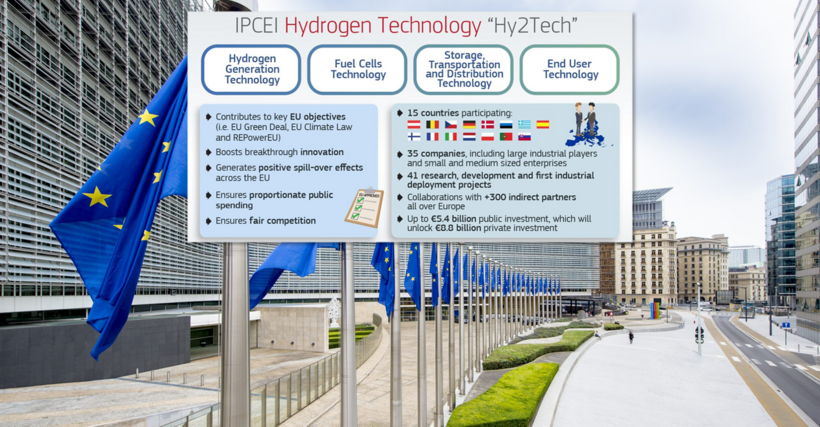
The so called "Important Projects of Common European Interest" (IPCEI) are at the forefront of Europe's energy transition and focus on advancing key technologies in the field of hydrogen. These ambitious projects cover the entire value chain, from hydrogen and fuel cell production, transport and storage to the use of hydrogen in industry and mobility. The focus of the first generation, the so called Hy2Tech, is on production and industrial applications, while transport and storage are addressed more intensively the later ones.
The implementation of the Hy2Tech projects with a referring funding of 5.4 billion € enabled in total 35 European companies to overcome technological hurdles, create new jobs and open up promising markets in accordance with the EU objectives. After more than two years since the approvement of the first generation IPCEI projects, the Fuel Cell Compass is reviewing the progress while highlighting three particularly promising projects below.
HyMotive: A key project for the development of hydrogen fuel cells as part of the IPCEI hydrogen program
Symbio's HyMotive project is belonging to the ambitions of the IPCEI program in the mobility sector. The project focuses on the development and production of advanced fuel cells with the aim of increasing the competitiveness of this technology and significantly advancing the market for hydrogen-based zero emission mobility in Europe. The core of the project is the development of fuel cell systems for a wide range of vehicles, including light commercial vehicles and heavy-duty trucks. Symbio aims to make fuel cell technology a viable competitor in the mobility sector by 2030.
The SymphonHy Gigafactory in Saint-Fons, France, is the centrepiece of the manufacturing strategy. An annual capacity of 50,000 fuel cell systems is the starting point for significant scaling. The planned expansion with a second Gigafactory by 2028 aims to double the capacity to 100,000 systems per year. The industrial base is also being strengthened through strategic partnerships such as the joint venture "Innoplate" with Schaeffler for the production of bipolar plates and the collaboration with Stellantis to diversify hydrogen supply across vehicle segments. Symbio also plans to create 1,000 new jobs as a result of the project. The project gained further momentum with the start of production at the SymphonHy Gigafactory in October 2023 and the planned business ramp-up of Innoplate in 2024.
The total investment of one billion euros, supported by funding from the EU and the French government, underscores the importance of the project to Symbio.
After reviewing the published information, it can be concluded that Symbio's HyMotive project appears to be largely on schedule. The commissioning of the SymphonHy Gigafactory and the rapid start of fuel cell system production indicate that the communicated milestones have been achieved. In addition, the production capacity of 50,000 systems per year is already reached, despite not utilized fully as of now. In addition, the expansion to 100,000 systems by 2028 is in preparation.
Development of zero-emission heavy-duty fuel cell trucks: The Pegasus project from Daimler Truck
The Daimler Trucks project "Pegasus" is developing zero-emission heavy-duty fuel cell trucks for long-distance transportation. The main objective of the project is to demonstrate the technical and operational feasibility of this technology. As the main USP, the trucks are equipped with on-board storage tanks for liquid hydrogen, enabling a range of more than 1,000 kilometers without refueling. This makes them competitive with conventional diesel trucks and give them an advantage over battery-powered alternatives in long-haul transportation.
During a four-year test phase, the practical suitability is evaluated under real operating conditions. The project received substantial funding from the IPCEI hydrogen program as well as additional funding from the state of Baden-Württemberg of around 54.3 million euros. Further funding plans from German governmental side are planned to further enable the industrialization. The PEGASUS project can make a significant contribution to the establishment of fuel cell trucks in long-distance transportation and strengthen Europe's position in hydrogen mobility in the long term.
Based on the information currently available, the project appears to be largely on schedule. This is due to the fact that the Daimler Trucks Group has already reached an advanced stage in the development of its hydrogen trucks. From mid-2024, some companies will have the opportunity to test CO2-free long-distance transport solutions. The test phase is expected to last one year, which is in line with the original schedule. However, there are still challenges to overcome, particularly with regard to funding, which will have to be made available following the Federal Constitutional Court's ruling on the budget in Germany.
In addition, an appropriate refueling and charging infrastructure is needed, which requires the further commitment of politicians and energy companies.
Bosch Power Units: First industrialization of stationary fuel cell systems
The "Bosch Power Units" project aims to establish stationary Solid Oxide Fuel Cell (SOFC) systems on an industrial scale. The target electrical output of the systems is 100 kW, with an efficiency of 60 % and an overall efficiency of up to 90 % by using waste heat. The ability to use different fuels, including hydrogen, biomethane and natural gas, ensures versatility and easy integration into existing and future infrastructures.
Applications are diverse and include different industries, data centers, retail, hospitals, households, virtual power plants, storage stations, and the maritime industry. Bosch plans to build a comprehensive physical and digital production infrastructure for 100 kW modular SOFC systems, including supplier integration as well as test and inspection facilities. The start of series production is planned for 2025 with a capacity of 200 MW of electrical power, which is enough to supply more than 400,000 four-person households. The main production and development sites are located in Bamberg, Homburg, Wernau and Stuttgart.
The project is funded by the IPCEI hydrogen program with more than 161 million euros. The German government is covering 70% of the project costs, which corresponds to a contribution of approximately 126.9 million euros. The remaining 30% will be covered by the states of Baden-Württemberg, Bavaria and Saarland. The "Bosch Power Units" project appears to be largely on schedule. The project was launched at the beginning of 2022, after the relevant authorities granted permission for an early start at the company's own risk. Bosch aims to start the world's first industrial series production of SOFC systems in 2025, which is in line with the original schedule.
Nedstack's gigafactory project: Ambitions put on hold due to financial turbulence
As part of the Hy2Tech program, Nedstack, a Dutch developer and manufacturer of PEM fuel cell solutions, had planned an ambitious project to build a fuel cell Gigafactory. The project, known as the Fuel Cell Giga Factory (FCGF), was to be located at the Kleefse Waard industrial park in Arnhem. It was planned to have an annual production capacity of one gigawatt of stack power, making it the largest factory of its kind in Europe. The company applied for and received a 20 million euros grant from the IPCEI program to realize the project. Construction was scheduled to begin in 2022, with the factory becoming operational in 2026. The project also included extensive research and development programs to reduce the cost of hydrogen solutions.
However, Nedstack's current financial situation suggests that the project will be discontinued. On February 6, 2024, the company announced that it was insolvent. This development casts doubt on the future of the FCGF project. Rising costs and slow financing mechanisms are cited as reasons for the financial difficulties. Although the company is insolvent, there are signs that Nedstack is still active and in particular looking for ways to continue its maritime business. However, the future of the IPCEI project remains uncertain and it is currently impossible to predict whether and in what form the project can be continued or whether it will have to be discontinued altogether.
Resume on exemplary projects of the first generation of IPCEI hydrogen projects
In conclusion, the IPCEI hydrogen projects represent Europe's ambitious sustainable energy vision. However, a critical analysis shows that these initiatives face significant challenges and potential weaknesses. One of the main challenges, especially in the context of mobility, is the development of a continental infrastructure. The success of the projects depends largely on whether the necessary investments are taken, and the necessary coordinated efforts are made to develop the appropriate infrastructure.
Political and regulatory uncertainties are also significant risk factors. Changes in the political landscape or adjustments to the regulatory environment could jeopardize the long-term support for these projects and thus their future viability. While the IPCEI projects undoubtedly represent innovative approaches, their long-term success will largely depend on the extent to which they are able to effectively address the challenges outlined above.
The Nedstack project is a prime example of the potential risks associated with the implementation of IPCEI projects. It highlights the need for policy makers and investors to adequately consider the associated challenges and potential risks. This underlines the urgent need to critically evaluate and, if necessary, adjust funding schemes and investment strategies in the hydrogen sector.
Sources
Downloads
Hier informieren wir regelmäßig über alle wichtigen Entwicklungen im Bereich des Wasserstoffs, der Brennstoffzelle und des Elektrolyseurs.
Whitepaper: In-line Viscosity Measurement
Download a white paper on innovative solutions in the areas of real-time process monitoring and quality assurance
