
Airbus UpNext and Toshiba Partner on Superconducting Technology for Hydrogen-Powered Aircraft
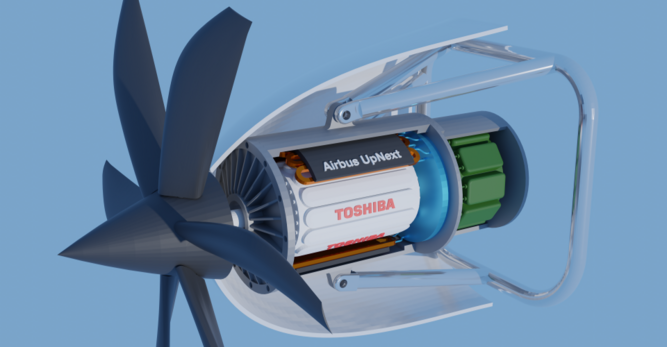
Airbus UpNext, a subsidiary of Airbus, and Toshiba Energy Systems & Solutions Corporation (Toshiba) have announced a partnership to explore the use of superconducting technologies in hydrogen-powered aircraft. The collaboration aims to advance the development of superconducting motors, which could enhance the efficiency and performance of future hydrogen-powered aircraft.
Liquid hydrogen empowering superconducting technologies
Hydrogen-powered aircraft are considered a potential solution to decarbonize the aviation industry and help achieve net-zero emissions by 2050. Superconducting technology, which utilizes cryogenic temperatures (such as the -253°C required for liquid hydrogen fuel) offers the possibility of significantly improving power transmission within electric propulsion systems.
Representatives from both companies emphasized the significance of the partnership for advancing aviation technology. Grzegorz Ombach, Senior Vice President at Airbus and Head of Disruptive Research & Technology, noted that the collaboration could enable progress beyond the capabilities of existing electrical motor technologies, while Tsutomu Takeuchi, a Corporate Officer at Toshiba, highlighted the potential impact of superconducting technology on the future of aircraft design and the decarbonization of the aviation sector.
Joining forces with the respective fields of experience
The companies plan to jointly develop a two-megawatt superconducting motor, with the agreement signed at the Japan Aerospace 2024 event in Tokyo. The signing was attended by Dr. Ombach and Mr. Takeuchi, along with other representatives from both Airbus and Toshiba.
Airbus has been working on superconducting technologies over the past decade, with recent efforts including the Cryoprop demonstrator, which is designed to test a two-megawatt superconducting electric propulsion system. Toshiba has been involved in superconducting technology research for nearly 50 years and released a two-megawatt superconductivity motor prototype for mobility applications in 2022. The collaboration marks the first major initiative under the Airbus Tech Hub Japan, which was launched in May 2024 to foster partnerships aimed at advancing aerospace research, technology, and innovation.
Source
Downloads
Hier informieren wir regelmäßig über alle wichtigen Entwicklungen im Bereich des Wasserstoffs, der Brennstoffzelle und des Elektrolyseurs.
Whitepaper: In-line Viscosity Measurement
Download a white paper on innovative solutions in the areas of real-time process monitoring and quality assurance
