
cellcentric Begins Pilot Production of Fuel Cell
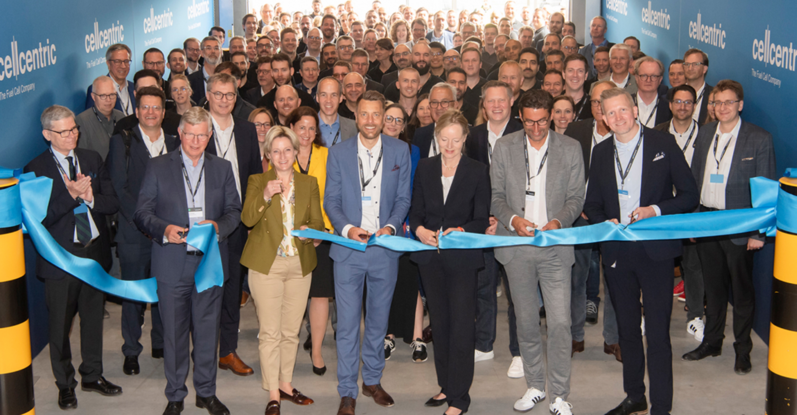
cellcentric has inaugurated pilot production for fuel cell systems at its Esslingen-Pliensauvorstadt site, marking another step towards mass production. By the end of the decade, solutions for long-haul trucks powered by fuel cell systems shall be developed here, aiming to advance sustainable mobility in the heavy-duty and freight transport sectors.
Industrial-scale production while achieving the optimum TCO
cellcentric aims to develop, manufacture, and globally distribute large-scale propulsion solutions in Baden-Württemberg that achieve optimal Total Cost of Ownership (TCO) in the competitive transport industry. Additionally, cellcentric plans to cover the entire ecosystem around fuel cell systems – from product development and maintenance to recycling at the end of the lifecycle.
"The fuel cell technology is a now proven solution for emission-free long-haul heavy-duty transport. However, industrial-scale production has yet to be realized. Achieving this is key to optimizing Total Cost of Ownership (TCO) and securing a strong competitive position for cellcentric in the long term," said Lars Johansson, Chief Commercial Officer and Chief Organizational Officer of cellcentric GmbH & Co. KG. "The opening of our pilot production in Esslingen is not the end of our mass production journey but a blueprint for the next step. We will continue to drive the industrialization and scaling of fuel cell system production at our Weilheim site in the coming years," Johansson added.
At the opening ceremony on June 20, Lars Johansson and the cellcentric leadership welcomed numerous guests from politics, business, associations, and academia, including Baden-Württemberg Ministers Dr. Nicole Hoffmeister-Kraut (Economy, Labor and Housing) and Thekla Walker (Environment, Climate and Energy), Esslingen District Administrator Heinz Eininger, and the mayors of Esslingen, Matthias Klopfer, and Weilheim, Johannes Zuefle.
Establishment of automated processes for high production volumes
The facility in Esslingen-Pliensauvorstadt would provide an ideal location for the production of fuel cell systems. Over 100 employees will utilize approximately 10,300 square meters of production and logistics space, along with office and administrative areas. The site is part of the greenfield industrial park in Esslingen.
cellcentric will next establish the necessary manufacturing processes at this site to prepare for high-volume production of fuel cell systems. With complete production under one roof and a high degree of automation, the company expects to achieve excellent value creation, ensuring long-term stable economic development.
The complete process chain includes the following manufacturing steps:
- Ink Mixing & Coating: Precise mixing of various raw materials to create a dispersion for subsequent roll coating.
- Membrane Electrode Assembly (MEA): Automated assembly of cell components into individual cells suitable for mass production.
- Sealing: Fully automated injection molding process to apply seals.
- Stacking: Automated stacking of the complete fuel cell stack.
- Assembly: Integration of all fuel cell system components according to automotive mass production standards.
- Inline Quality Testing: Strict automated testing protocol throughout the production process to quickly and reliably identify and correct errors, ensuring continuous quality compliance until the product is ready for delivery.
Fuel Cell Ecosystem Beyond Product Lifecycle
Beyond developing and producing fuel cell systems for heavy-duty transport, cellcentric would establish a comprehensive ecosystem around these complex assemblies. Customers shall receive products of unique quality and seamless integration of propulsion solutions into vehicle management. A complete service package, including all maintenance and repair services, shall minimize downtime and unforeseen failures, crucial for optimal vehicle utilization in the transport industry.
In line with its commitment to sustainability, cellcentric would plan an eco-friendly return process for fuel cell systems at the end of their lifecycle. The company's circular economy concept aims to handle resources, materials, and products as efficiently as possible through four steps:
- Reuse: Utilizing decommissioned fuel cell systems for other applications with lower demands.
- Refurbishment: Extending product life through reconditioning.
- Remanufacturing: Completely overhauling systems to like-new condition.
- Recycling: Recovering raw materials for reuse in fuel cell production.
New products are almost ready to be produced
In May 2024, cellcentric unveiled its more compact, powerful, and efficient NextGen fuel cell system for hydrogen-powered long-haul trucks at the ACT Expo in Las Vegas, USA. The company’s BZA150 fuel cell generation, which would already be a practical and near-production pilot product, would have been successfully tested in demanding field trials by truck manufacturers Daimler Truck and Volvo Group. The start of series production for the NextGen fuel cell system is planned for the end of the decade.
Source
Downloads
Hier informieren wir regelmäßig über alle wichtigen Entwicklungen im Bereich des Wasserstoffs, der Brennstoffzelle und des Elektrolyseurs.
Whitepaper: In-line Viscosity Measurement
Download a white paper on innovative solutions in the areas of real-time process monitoring and quality assurance
