
Daimler Truck Expands Hydrogen Testing Despite Infrastructure Challenges
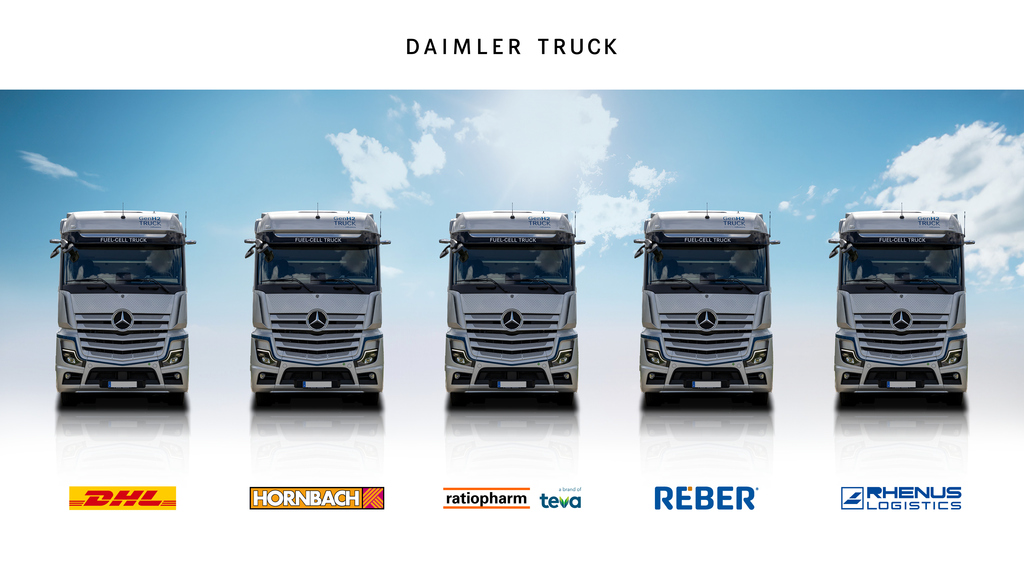
Daimler Truck has begun the second phase of real-world testing for its Mercedes-Benz GenH2 hydrogen fuel cell trucks, deploying five vehicles with major German logistics operators. The move comes as the manufacturer acknowledges that slower-than-expected infrastructure development will delay large-scale production until the early 2030s.
Five Companies Join Extended Trials
Hornbach, Reber Logistik, Teva Deutschland (ratiopharm), Rhenus, and DHL Supply Chain will each operate a GenH2 Truck for approximately one year on regular routes within Germany. The tests will span applications from temperature-controlled pharmaceutical transport to recycling logistics and long-distance freight operations.
DHL Supply Chain plans to pair its fuel cell truck with an electric refrigerated trailer on routes across Baden-Württemberg, Hesse, and North Rhine-Westphalia. Katrin Hölter, CEO of DHL Supply Chain Germany & Alps, said the combination demonstrates that "sustainable logistics works today, even for sensitive frozen and fresh products".
Teva Deutschland will use the vehicle for nationwide pharmaceutical deliveries to hospitals, wholesalers, and pharmacies. Hornbach will deploy its truck in the company's recyclable materials fleet, which has operated for over a decade as part of the retailer's closed-loop recycling system.
Performance Data From First Phase
The initial testing phase, completed with five different partners earlier this year, produced operational data from more than 225,000 kilometres of real-world driving. Hydrogen consumption ranged from 5.6 to 8.0 kilograms per 100 kilometres, depending on the application and total vehicle weight, which varied between 16 and 34 tonnes.
The GenH2 Truck operates with a fuel cell system delivering up to 300 kW continuous power, supplemented by a small battery for peak loads and regenerative braking. With a gross vehicle weight of approximately 40 tonnes and a payload of around 25 tonnes, the truck is designed to match the technical specifications of conventional diesel long-haul vehicles.
Infrastructure Constraints Shape Timeline
The vehicles rely on liquid hydrogen (sLH2) rather than compressed gas, which offers higher energy density and longer range. However, the trucks can currently only refuel at two specialized stations—one in Wörth am Rhein and one in the Duisburg area.
Reber Logistik acknowledged this limitation in its deployment plan. "Since we can only refuel the truck in Duisburg and Wörth for now, we will use it specifically in this region," said managing director Mirko Kauffeldt.
Michael Scheib, head of overall vehicle development at Mercedes-Benz Trucks, stated that customer-based testing represents "another step on the way to series production—and to CO2-neutral transport with battery and hydrogen".
Production Plans Adjusted
Daimler Truck has started development of its next-generation fuel cell trucks and plans to build 100 units in small series production at its Wörth plant, with customer deployment beginning in late 2026.
The company confirmed that large-scale industrialization of fuel cells and planned series production will focus on Europe in the early 2030s, a delay attributed to infrastructure development progressing more slowly than anticipated. The manufacturer noted that customers will not be able to deploy hydrogen trucks in significant numbers over the next few years.
Daimler Truck continues to pursue a dual strategy for decarbonization, developing both battery-electric and hydrogen fuel cell vehicles.
Source
Downloads
Hier informieren wir regelmäßig über alle wichtigen Entwicklungen im Bereich des Wasserstoffs, der Brennstoffzelle und des Elektrolyseurs.
Whitepaper: In-line Viscosity Measurement
Download a white paper on innovative solutions in the areas of real-time process monitoring and quality assurance
