
Demonstrating the production of CCMs and MEAs for Fuel Cells
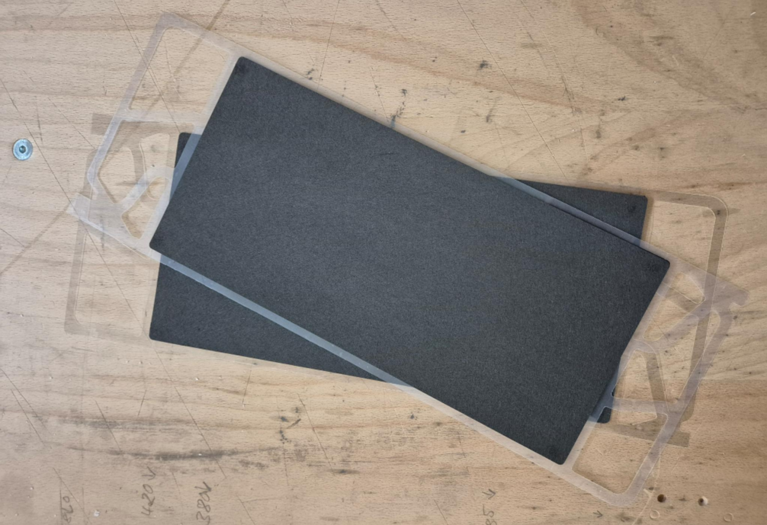
At the Chair for Production Engineering of E-Mobility Components (PEM), production technology for catalyst-coated membranes (CCM) and membrane electrode assemblies (MEA) is currently being established and commissioned. The flexible plant technology enables the production of CCMs and MEAs with various designs and geometries in a partially automated, industry-oriented environment.
The project
In the Fuel Cell Performance Production (FCPP) project, the aim is to establish innovative plant technology to produce CCMs and MEAs. Together with the project partners, a primary prototype was first developed following the "Return on Engineering" approach, which will subsequently be further developed into a prototype. This approach allows experiences from process development to be integrated into later prototypes. Additionally, other partners have focused on developing an efficient bipolar plate design or conducting accelerated aging tests.
The production of the CCM
The coating system at the PEM Chair is currently being commissioned. The innovative approach of the coating process lies in utilizing the conventional decal process while reusing the decal material, thereby conserving valuable resources. The coating is applied using a slot die with a width of up to 300 mm. The subsequent drying process is performed in a hybrid manner using infrared and convection drying. The coated decal is then transferred with the membrane into a joint hot-pressing process, allowing the catalyst layer to be transferred onto the membrane. By applying a protective film, the coating can be shielded from unintended influences.
The coating system enables the generation of valuable research insights. For instance, a key focus of the research landscape is understanding the impact of individual process errors and how they affect the performance of the produced layers. Additionally, the existing plant technology at PEM allows for the investigation of scaling effects between small-scale systems and industry-oriented prototypes, as well as how these effects should be evaluated in the context of product and process development.

Figure 1: Insights to the coating line at PEM, Source: PEM
The production of the MEA
After the CCM is manufactured, the assembly process to create the MEA can follow. The MEA consists of the CCM, two subgaskets that frame the CCM, and two gas diffusion layers (GDL) that are placed onto the subgasket. The assembly area comprises four main sections: cutting, joining, lamination, and adhesive application.
The cutting is performed using a punch with a special die fixation. This die fixation ensures that the foils can be cut in a precisely defined position, which is crucial for maintaining the required tolerances.
The joining of the foils takes place on a foldable vacuum table, allowing the cut foils to be layered on top of each other without bubbles.
Subsequently, the CCM and the subgaskets are laminated. The foil sandwich is fixed using adhesive, which is typically temperature-activated.
The adhesive application is carried out in a 3D gantry system. The adhesive can be either self-curing or UV-curing. In the latter case, a separate UV unit can be used to transition the adhesive into a tape phase. This allows the GDL to adhere to the subgasket, finalizing the MEA, which can then be forwarded for transport or shipment.

Figure 2: Applying the adhesive to the subgasket to fix the GDL, Source: PEM
Downloads
Hier informieren wir regelmäßig über alle wichtigen Entwicklungen im Bereich des Wasserstoffs, der Brennstoffzelle und des Elektrolyseurs.
Whitepaper: In-line Viscosity Measurement
Download a white paper on innovative solutions in the areas of real-time process monitoring and quality assurance
