
Development of Hydrogen-Powered Toyota Hilux Advances to Next Phase
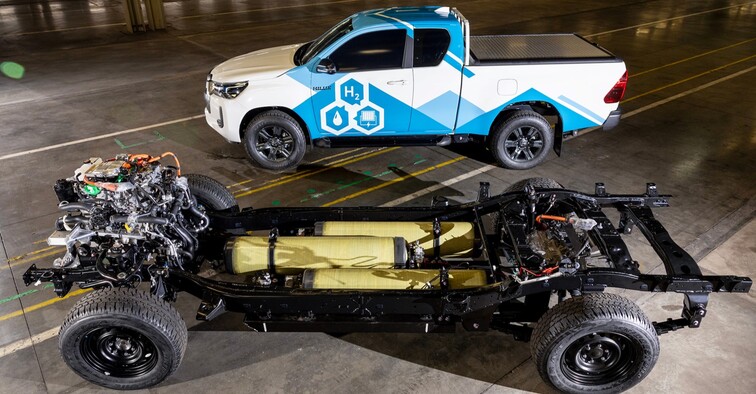
The hydrogen-powered Toyota Hilux has entered the testing and demonstration phase. The first ten units of the fuel cell pickup were produced at Toyota Motor Manufacturing UK's facility. The model was first presented to the public in September 2023.
Ten prototypes for field tests and demonstration purposes
With the fuel cell-powered Hilux, Toyota is making strides towards climate neutrality, supporting its multi-path approach to addressing diverse propulsion needs and markets. This approach includes hybrid and plug-in hybrid vehicles, pure electric cars, fuel cell models, and combustion engines using e-fuels, tailored to regional requirements and customer lifestyles.
The first ten prototypes of the fuel cell Hilux were manufactured at Toyota's Burnaston plant in the UK. Five vehicles are currently undergoing rigorous field tests to assess safety, performance, functionality, and durability. The other five are being used for demonstration purposes with customers and the media, including at the upcoming Olympic and Paralympic Games in Paris. By introducing customers to hydrogen fuel cell technology, Toyota is laying the groundwork for a sustainable future in transportation.
Toyota anticipates Europe to be one of the largest markets
Insights gained from the Hilux project, combined with Toyota's 30-plus years of hydrogen research and development, aim to advance the next generation of fuel cell technology. These future systems are expected to offer longer life cycles, greater range, and significantly reduced costs.
Toyota anticipates that Europe will be one of the largest markets for fuel cells by 2030, with continuous growth in mobility and energy sectors. In December 2023, Toyota Motor Europe announced the "Hydrogen Factory Europe" to promote the development of hydrogen ecosystems and infrastructure in the region, where the fuel cell Hilux project plays a crucial role.
Three high pressure hydrogen tanks for 600 km range
The hydrogen-powered Hilux prototype maintains the renowned quality, durability, and reliability of the Hilux brand, which has been in production since 1968. The model has proven its resilience in extreme environments such as the North Pole, Icelandic volcanoes, and Antarctica, and has won the Dakar Rally three times.
Externally, the prototype is indistinguishable from the standard Hilux, with dimensions of 5,325 x 1,855 x 1,810 millimeters (L x W x H). The fuel cell system, also used in the Toyota Mirai, provides a range of up to 600 kilometers, surpassing that of battery electric vehicles. The hydrogen is stored in three high-pressure tanks with a total capacity of 7.8 kilograms, integrated into the chassis. The fuel cell stack, containing 330 cells, is positioned above the front axle, driving an electric motor on the rear axle that delivers 134 kW (182 hp) and 300 Nm of torque, emitting only water vapor.
A portion of the electricity generated by the fuel cell is stored in a lithium-ion battery located beneath the rear cargo area, preserving cabin space.
Several project partners began the project in 2022
The project began in early 2022 with a feasibility study by TMUK and Toyota Motor Europe, followed by funding from the UK's Advanced Propulsion Centre. This enabled a comprehensive design and development program involving partners such as Ricardo, ETL, D2H Advanced Technologies, Thatcham Research, and support from Toyota Motor Corporation.
Components were produced between February and May 2023, with the first prototype built at TMUK's specialized facility. Ricardo supported the technical integration. The first prototype was completed in three weeks in June 2023, with nine more prototypes produced by the end of 2023, undergoing various tests.
The ten prototypes are now in the final phase of field and customer testing.
Source
Downloads
Hier informieren wir regelmäßig über alle wichtigen Entwicklungen im Bereich des Wasserstoffs, der Brennstoffzelle und des Elektrolyseurs.
Whitepaper: In-line Viscosity Measurement
Download a white paper on innovative solutions in the areas of real-time process monitoring and quality assurance
