
Electrification of Heavy-Duty Transport in Germany: The SeLv Project
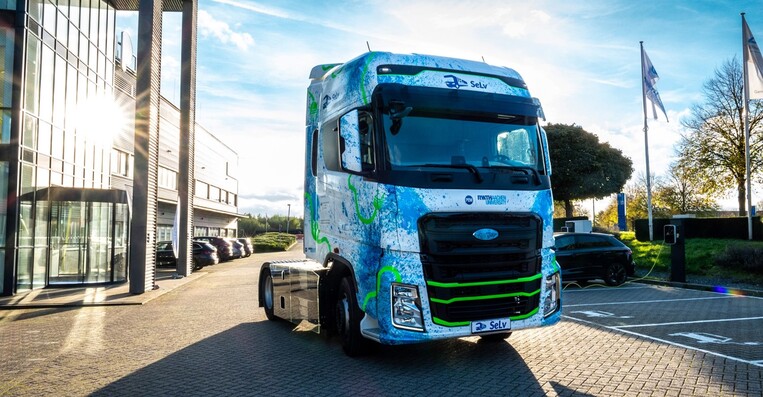
The transportation sector accounts for 20 percent of Germany's nationwide greenhouse gas emissions, with around 35 percent attributed to heavy-duty and commercial vehicles. Therefore, heavy-duty transport contributes significantly, with seven percent of greenhouse gas emissions, to environmental pollution in Germany. Achieving climate goals requires electrifying not only passenger cars but also heavy-duty vehicles. A promising solution is the electrification of trucks and the use of hydrogen as an energy carrier. In addition to introducing new electric trucks, there is another sustainable option: retrofitting existing vehicles. The SeLv project aims to develop heavy-duty trucks for emission-free logistics in heavy-duty transport through an electrification kit and an economic production system. This includes retrofitting both new and existing vehicles. The modular electrification kit enables cost-effective conversion to emission-free heavy-duty trucks and allows for application-specific configuration of drive trains.
One of the technical challenges of retrofitting is packaging within the given space and the secure implementation of interfaces to the donor vehicle. Another challenge is integrating components of the fuel cell-electric drive train, which consists of an electric drive axle, traction battery, and fuel cell system.
The SeLv project involves building three vehicles. The first vehicle serves as a prototype to demonstrate the integration and control of components. The second vehicle is a near-series prototype, where the goal is to integrate and control components to obtain approval through a single operating permit. The third vehicle aims to represent the series status and also include the integration and control of components, this time with the aim of obtaining approval through a multi-stage type approval.
The developed solution integrates both a fuel cell system and a traction battery into the electric drive train. This enables heavy-duty trucks to handle both long-haul and distribution transport. The SeLv project focuses on industrializing production processes for the drive train to create cost-effective solutions and accelerate the use of electric vehicles in the heavy-duty transport sector.
The goals of the SeLv research project include conceptualizing and validating a modular electrification kit for drive train configuration, as well as concept adaptation and evaluation of various hydrogen pressure storage levels. By combining battery and fuel cell, the vehicles are expected to achieve a range of over 1000 km.
With a continuous power output of 460 kW, a configurable hydrogen tank of at least 68 kg, and a configurable net battery capacity of at least 300 kWh, the SeLv project aims for a significant reduction in greenhouse gas emissions in the heavy-duty transport sector. The development of an economic production system for the modular electrification kit sets the stage for broad application of this innovative approach and paves the way for a more sustainable future in the transport sector.
As part of the SeLv project, the Production Engineering of E-Mobility Components chair at RWTH Aachen University is developing a modular drive train for trucks that allows for individual configurations as needed. This drive train integrates a fuel cell system with an electric drive unit and aims to drive industrialization of production processes for the drive train to achieve volume-based cost advantages in manufacturing. The SeLv project is funded by the German Federal Ministry of Transport with around 16.9 million euros.
For more information and updates on the SeLv project visit the official project website (Link) or contact the PEM chair.
Downloads
Hier informieren wir regelmäßig über alle wichtigen Entwicklungen im Bereich des Wasserstoffs, der Brennstoffzelle und des Elektrolyseurs.
Whitepaper: In-line Viscosity Measurement
Download a white paper on innovative solutions in the areas of real-time process monitoring and quality assurance
