
Excursus: Is Europe heading towards a raw materials crisis?
The transformation to a climate-neutral economy in Europe requires not only financial investment, but also new and old raw materials in quantities that were previously not needed. Materials such as rare earths, graphite and platinum are essential for fuel cells, batteries, electric drives and generators as well as electronic components. In view of the increasing protectionism in global trade and the economic dependence of the producing countries, the risk of supply bottlenecks is growing. Companies, countries and the EU as a group are therefore called upon to recognize these risks at an early stage and develop appropriate strategies to secure supplies for economic change.
Classification of critical raw materials by the EU
An important point of reference for categorising the criticality of raw materials is the European Commission's regularly published report, in which "critical raw materials" are identified. In 2025, the list already includes 34 materials. Demand for around half of these raw materials is forecast to grow exponentially in the coming years. The assessment of whether a raw material is to be categorised as critical is based on quantitative indicators such as the political stability of the producing countries or substitutability.
Technology and circularity as a solution
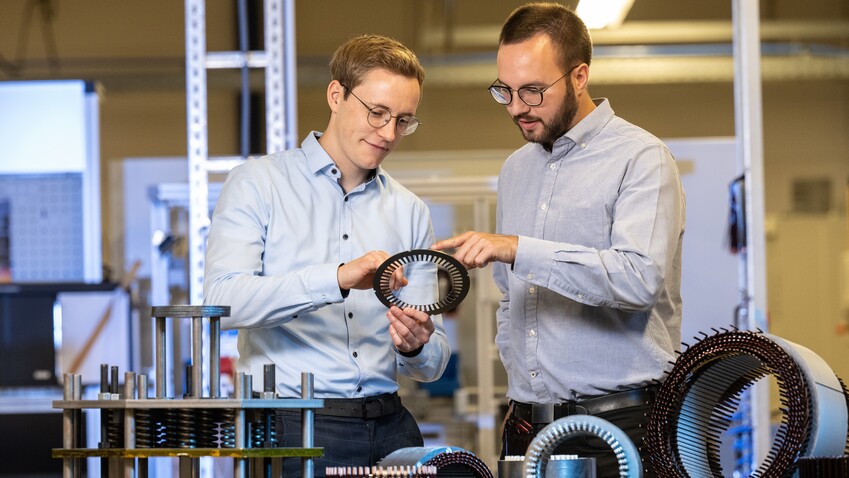
Technological innovations and approaches to the circular economy represent solutions for reducing the demand for critically categorised raw materials. For example, the average copper requirement per kilowatt in electric motors could be reduced by 43% between 2020 and 2023 by using hairpin technology instead of round wire windings. Such developments illustrate how technical innovations can reduce the pressure on raw material markets.
Material criticality in a corporate context
In a current material study, the PEM at RWTH Aachen University is focussing intensively on the issue of material criticality in the corporate context of electric motors. The aim is to better understand supply risks, identify potential risks and highlight options for action. It should be noted that the criticalities identified by the EU cannot simply be applied to individual companies. At company level, additional factors such as flexibility in supplier selection, specific substitution options or the individual procurement strategy play a decisive role. In order to capture these dimensions holistically, the PEM collects data with the help of surveys along the entire supply chain, from OEMs and tier 1 suppliers to raw material suppliers. Such a differentiated approach makes it possible to recognise real risks at an early stage and address them effectively.
Sources
Chair of Production Engineering of E-Mobility Components (PEM) of RWTH Aachen University
Downloads
Hier informieren wir regelmäßig über alle wichtigen Entwicklungen im Bereich des Wasserstoffs, der Brennstoffzelle und des Elektrolyseurs.
Whitepaper: In-line Viscosity Measurement
Download a white paper on innovative solutions in the areas of real-time process monitoring and quality assurance
