Exploring the Diverse World of Electrolysis: Types and Applications
Through electrolysis, water is separated into hydrogen and oxygen, creating opportunities for sustainable production of hydrogen. Regardless of the specific variety, the basic concept of electrolysis stays consistent. However, the technologies used vary based on physical, chemical, and electrochemical factors. At present, four electrolytic technologies exist, which are outlined below.
Sold Oxide Electrolysis (SOEL) serves high efficiencies
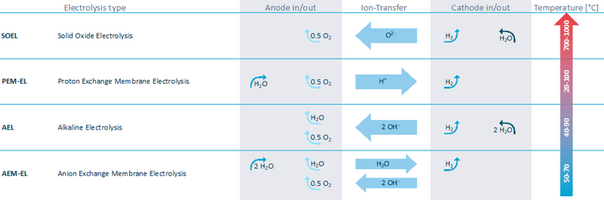
For the SOEC a hard, non-porous ceramic electrolyte is used to separate the anode and cathode. This electrolyte exhibits semi permeability to oxygen ions (O2-), which are generated at the cathode through the reduction of water vapor. Simultaneously, hydrogen is formed during this reaction and subsequently removed from the system. On the anode side, oxygen ions oxidize to form oxygen and electrons. The extreme operating temperatures, reaching up to 1000°C, necessitate the use of special materials and seals. They also lead to prolonged system startup times, which is why SOEL are usually operating the whole time.
Alkaline Electrolysis (AEL) is the most mature type of electrolysis
AEL is a mature technology for H2 production up to the MW scale, and represents the most widely used electrolytic technology on a commercial level worldwide.
The AEL includes the process of water electrolysis in a basic electrolyte, usually potassium hydroxide (KOH). This method has been commonly employed since the middle of the 20th century. When the cathode is exposed to temperatures ranging from 40-90°C and pressures of approximately 30 bar, oxidation occurs, leading to the generation of hydroxide ions. The oxidized hydroxide ions can pass through the diaphragm - other than the remaining hydrogen, which is released at the cathode. At the anode, the diffused hydroxide ions are oxidized further to create oxygen and water. The benefits of AEL include a prolonged lifespan of around 90,000 operational hours, stemming from the advanced stage of development of the technology. Moreover, it is currently the most economical feasible electrolysis method due to the fact that it does not rely on precious metals as catalysts. Additionally AELs can achieve a hydrogen purity of 99.8%.
Major challenges associated with AEL are the handling of the corrosive electrolyte and limited current densities. Furthermore, the diaphragm does not completely prevent the cross-over of gases from one half-cell to another.
Proton Exchange Membrane Electrolysis (PEM-EL) support dynamic and flexible operation
The PEM-EL features a polymer electrolyte membrane that serves as a barrier between the anode and cathode. This membrane enables the permeation of protons (H+) and is impermeable to electrons, oxygen, and water molecules.
Through oxidation on the anode side, protons, oxygen and electrons are generated. The protons then diffuse through the membrane to the cathode side and combine with electrons to form hydrogen, which is then transported out of the cell as a dissolved gas in water.
The PEM electrolyzer offers several advantages, including a compact cell design and the possibility of dynamic operation. It is also characterized by high efficiencies of approximately 53-71%. Due to the low operating temperature between 20-80°C the PEM electrolyzer requires in general less than 15 minutes for a cold start.
The principle difference between PEM-EL and AEL lies in the significantly higher current densities achievable by a PEM-EL that leads to higher production rates and more compact systems.
Anion Exchange membrane electrolysis (AEM-EL) is the fusion of AEL and PEM-EL
The system and architecture of the AEM-EL is similar to a PEM-EL, although it uses less expensive materials. Some of the materials are derived from alkaline electrolysis, which has led to the AEM electrolyzer often being referred to as a fusion of AEL and PEM-EL.
At the cathode of the AEM-EL, water is reduced to produce hydrogen and hydroxide ions. These hydroxide ions then diffuse through the anion exchange membrane and oxidize at the anode to form water and oxygen. AEM-EL has the advantage of neither requiring precious metals within its catalysts nor titanium in the cell, making it less cost-intensive than the PEM-EL. It also operates at differential pressure and has low ohmic losses.
Research on AEM systems to date has been limited to the laboratory scale with focus on developing electrocatalysts, membranes and understanding operational mechanisms with the general objective of obtaining a high efficiency, low cost and stable AEM devices. Currently, only few market-ready products exist, while the expectations of the market remain high for the AEM-EL technology.
Sources
Downloads
Hier informieren wir regelmäßig über alle wichtigen Entwicklungen im Bereich des Wasserstoffs, der Brennstoffzelle und des Elektrolyseurs.
Whitepaper: In-line Viscosity Measurement
Download a white paper on innovative solutions in the areas of real-time process monitoring and quality assurance