
Germany Turns 400 km Gas Pipeline into Hydrogen Artery
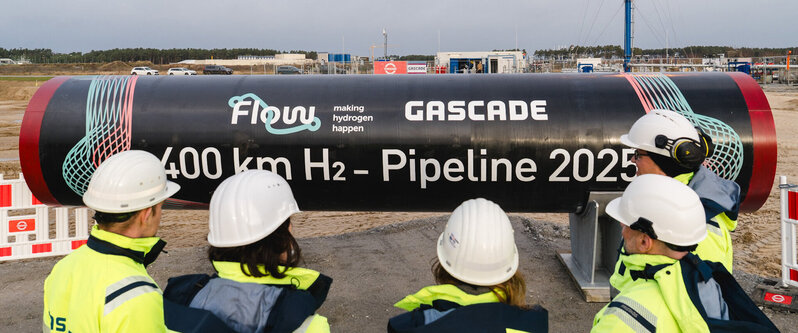
Germany has taken another step in turning its gas grid into a hydrogen backbone: transmission operator GASCADE has converted around 400 kilometers of existing natural gas pipeline to carry hydrogen, creating a new north–south corridor that is now open to the market.
A hydrogen spine for eastern Germany
The converted line forms part of “Flow – making hydrogen happen,” a project that links the Baltic Sea region with the industrial areas of Saxony-Anhalt, and is slated to become a central segment of Germany’s planned hydrogen core network. With the first sections now filled with hydrogen, GASCADE says the infrastructure can be used immediately by market participants, offering early transport capacity ahead of the broader build-out of the national grid.
From natural gas to hydrogen
Technicians have repurposed large-diameter pipelines, originally built for natural gas, to carry hydrogen, avoiding the costs and delays of constructing entirely new routes. According to GASCADE, the converted lines have a diameter of around 1.4 meters, and the company presents the switch as a pioneering engineering effort that demonstrates how existing grids can be reused in a relatively swift and cost‑efficient way.
Industrial and climate stakes
For industry in eastern Germany, the new corridor promises earlier access to low‑carbon hydrogen, which policymakers see as essential for decarbonising steel, chemicals and other energy‑intensive sectors. GASCADE frames the project as a contribution to cutting CO₂ emissions while giving companies planning certainty that transport capacity will be in place as hydrogen production and imports scale up.
Gateway to Baltic hydrogen
The pipeline is designed to receive hydrogen from several sources: production sites along the German Baltic coast, especially around Lubmin, as well as future imports routed via the port of Rostock and connections to the wider Baltic Sea region. GASCADE highlights the cross‑border dimension, noting that additional lines to Poland, the Czech Republic, Bavaria and Austria are planned or will be converted as part of the same programme.
First stage of a wider network
The section now in operation is described as a first step towards linking major industrial centres in southern Germany to hydrogen supplies by 2029 under the German hydrogen core network plan. As the “Flow – making hydrogen happen” project expands, the converted gas grid is set to become one of the backbones of a future European hydrogen market, with Germany positioning itself as a transit hub between northern production and southern demand.
Source
Downloads
Hier informieren wir regelmäßig über alle wichtigen Entwicklungen im Bereich des Wasserstoffs, der Brennstoffzelle und des Elektrolyseurs.
Whitepaper: In-line Viscosity Measurement
Download a white paper on innovative solutions in the areas of real-time process monitoring and quality assurance
