
"Green hydrogen isn’t automatically emissions-free"
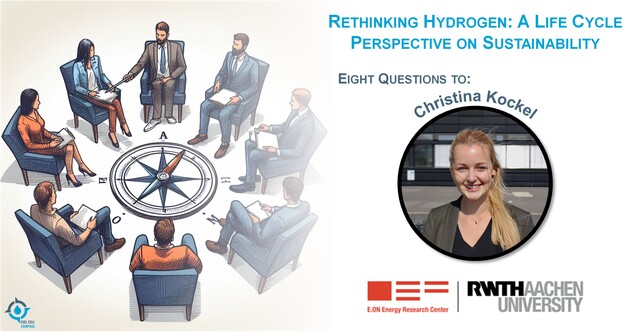
Christina Kockel is Chief Engineer at the Chair of Energy Systems Economics at E.ON Energy Research Center. Since 2019, Kockel has been pursuing her PhD, investigating uncertainty factors in the ecological assessment of energy technologies throughout their entire life cycle.
Her work has gained international recognition, most notably in 2022 when she received the award for the best young researcher contribution from the International Association for Energy Economics (IAEE).
In this interview, Christina Kockel challenges common assumptions about hydrogen’s sustainability, emphasizing the need for a full lifecycle perspective. She discusses why green hydrogen isn’t automatically emissions-free, the risks of overestimating its role in the energy transition, and the importance of strategic deployment where it adds real value.
Fuel Cell Compass: You have conducted research in the field of sustainable energy systems since you started your career at the Chair for Energy System Economics at the E.ON Energy Research Center of RWTH. What inspired you to enter this field and how has your research focus evolved over time?
Christina Kockel: From early on in my studies, I was fascinated by the systematic interconnections within energy systems. I focused particularly on the comprehensive environmental impacts of energy technologies, analyzing their effects across the entire lifecycle. At the Chair for Energy System Economics, our research is dedicated to understanding the interplay between energy technology, energy markets, and energy policy. A technology can be technically optimized to perfection, but its market success depends on how it compares to competing technologies. This is not only a question of costs but also of social acceptance.
One of my core research interests has always been determining where the use of a specific energy carrier makes sense from a systemic and holistic perspective—considering the full lifecycle emissions, rather than only the direct emissions during operation. Hydrogen is particularly interesting in this regard. Many studies assume that “green” hydrogen is entirely emission-free, but from a lifecycle perspective, this is not accurate. Even when produced from 100% renewable electricity, emissions arise from the manufacturing of production facilities and transportation infrastructure. Additionally, hydrogen requires more resources than, for example, direct electrification. Therefore, both from an environmental and economic perspective, it is essential to evaluate where hydrogen can truly add value.
FCC: Could you briefly explain how Life Cycle Assessment (LCA) is applied to the electrolysis technology and why it is important in assessing the sustainability of hydrogen?
Kockel: LCA evaluates the environmental impact of a product or technology throughout its entire lifecycle. This includes all stages of the value chain: raw material extraction, component manufacturing, transportation, operation, and end-of-life processes such as recycling or disposal. Emissions and waste streams are quantified and their effects across various impact categories using characterization models are assessed. The most widely recognized metric is the Global Warming Potential (GWP), measured in CO₂-equivalents per functional unit—in this case, per kilogram of hydrogen produced.
For electrolysis technology, we are currently focusing on two key phases. In the production phase the material composition and manufacturing of the electrolyzer is included, similar to CAPEX in economic calculations. A particular focus is placed on critical materials (e.g., iridium), which are essential for some electrolysis technologies.
The operational phase primarily accounts for energy consumption, which significantly influences the overall carbon footprint. When powered by renewable electricity (e.g., from solar or wind), emissions are mostly linked to the infrastructure investments in power generation. In contrast, if fossil energy sources are used, additional direct emissions arise during operation.
FCC: What are the key challenges in this for the large-scale deployment of a global hydrogen economy, and where do you see the most pressing need for intervention, innovation, and regulation?
Kockel: One of the biggest challenges for the global hydrogen economy is the high level of uncertainty—both in terms of costs and future demand. While many studies predict significant cost reductions for hydrogen, these projections are based on economies of scale and high production volumes. However, these reductions will only materialize if there is sufficient demand, which remains uncertain.
Today, hydrogen (especially green one) is still significantly more expensive than conventional fuels, including grey hydrogen. This makes it difficult for industries to justify the switch, as adopting hydrogen requires substantial investments in new infrastructure or modifications to existing systems.
Industrial applications are currently considered one of the key markets for hydrogen, particularly for hard-to-abate sectors. However, there are increasing efforts to develop alternative decarbonization technologies which could reduce the demand for hydrogen in certain industries.
The projected cost reductions for hydrogen rely on large-scale production. However, if the potential application areas shrink due to alternative technologies, less hydrogen will be needed, and the expected economies of scale may not be achieved. This creates a feedback loop, where high costs limit adoption, and limited adoption prevents cost reductions.
While several measures could help accelerate the hydrogen economy, they come with financial and strategic trade-offs. It is essential to carefully assess which policies and incentives are most effective in promoting sustainable solutions, while ensuring that hydrogen can ultimately establish itself in the market without relying on long-term subsidies.
Regulatory frameworks can help reduce investment risks by providing long-term clarity and stability. Instruments such as carbon pricing can make emissions-intensive alternatives less attractive, while financial incentives or long-term targets may help guide investment decisions. However, it is crucial to ensure that these measures support truly sustainable production and transformation pathways to prevent unintended shifts in environmental impacts, such as relocating emissions to other sectors or regions.
Infrastructure planning needs to be carefully aligned with demand projections. Investments in pipelines, storage, and distribution networks should be made in a way that avoids stranded assets and ensures efficient integration of hydrogen into the broader energy system.
Innovation support could help accelerate the development of hydrogen technologies, particularly in areas where costs remain high. Mechanisms such as Contracts for Difference (CfD), as introduced through H2Global, can temporarily bridge the cost gap, but should be designed in a way that ensures hydrogen technologies become self-sustaining in the long run.
FCC: Hydrogen is currently classified based on the energy source used for its production. How does your research contribute to assessing the CO2-footprint of hydrogen production?
Kockel: The EU Delegated Regulation (EU) 2023/1184 defines “green hydrogen” as hydrogen produced exclusively with renewable electricity. This can be achieved through direct coupling with a renewable energy plant or, under specific conditions, by using grid electricity—provided that criteria for additionality, temporal, and geographical correlation are met.
In our research, we go beyond these definitions by assessing the full environmental impact of hydrogen production, considering not only the electricity source but also the entire lifecycle of the electrolysis process. This includes both the construction of the electrolyzer and the environmental footprint of electricity generation. Even for wind and solar power, emissions arise from the production and installation of power plants, which need to be accounted for.
Additionally, we apply prospective LCA approaches, which consider future changes in the energy system. For example, as the electricity mix in a given country becomes less dependent on fossil fuels, the embedded emissions in products produced in this country such as electrolyzers and renewable power plants will also decrease.
Our research provides a more comprehensive picture of the CO₂ footprint of hydrogen, ensuring that “green hydrogen” is assessed not only by its electricity source but by its true environmental impact over its entire lifecycle.
FCC: What are the primary environmental drivers across the different hydrogen supply pathways, and what key factors should be considered in evaluating production, conversion, transportation, and reconversion?
Kockel: Ultimately, the overall environmental impact of hydrogen supply chains can be reduced by optimizing process efficiencies across the entire value chain, from electricity generation and hydrogen production to conversion, transportation, and reconversion.
While renewable electricity is a prerequisite for low-emission hydrogen production, the entire process must be considered. Even if hydrogen itself is generated using renewable energy, emissions can increase significantly if subsequent steps, such as conversion and transportation, rely on fossil-based energy sources—which is often the case in current electricity mixes.
To facilitate efficient transport, several conversion pathways are being explored, including ammonia, methanol, and Liquid Organic Hydrogen Carriers (LOHCs). While these options improve transportability, they come with additional energy demand and emissions, particularly if conversion processes occur in regions with a high fossil energy share.
The greenhouse gas footprint of hydrogen production is shaped by multiple factors, including the electricity source, electrolyzer efficiency, and plant utilization rates—as well as the availability and load factor of renewable power sources. Low plant utilization, for example, can lead to higher emissions per kilogram of hydrogen.
Moreover, conversion and reconversion processes introduce further energy losses and emissions. Converting hydrogen into ammonia, methanol, or LOHCs, and then back into hydrogen for end use, requires significant energy input. The exact efficiencies of some of processes are currently still uncertain, as many technologies are still at a low technology readiness level.
FCC: In the context of Germany’s and Europe’s energy transformation, what are the most suitable hydrogen supply pathways? Is there an optimal option for the future, or does it ultimately depend on specific circumstances?
Kockel: The optimal hydrogen supply pathway depends on various factors, particularly the actual long-term demand. From an environmental and economic perspective, locally produced hydrogen has the lowest emissions and could be cost-efficient, as long as it is sourced from renewable electricity with a high utilization rate of electrolysis capacity. However, large-scale hydrogen production is closely linked to electricity markets, as it increases the demand for renewable power and could impact grid stability and electricity prices. This makes integrating hydrogen production flexibly into energy systems an important consideration for ensuring both cost efficiency and sustainability.
In general, the utilization rate of both electrolyzers and the renewable energy plants powering them plays a crucial role. A higher capacity factor can sometimes compensate for the disadvantages of long transport distances, making imported hydrogen competitive in terms of emissions—if renewable energy is consistently used throughout the supply chain.
To achieve the lowest possible carbon footprint, it is essential to maximize the use of renewable energy across the entire value chain—not only for production but also for conversion, transport, and reconversion.
Additionally, diversifying hydrogen supply sources will be key. A balanced mix of domestic production and imports from multiple regions can reduce risks associated with geopolitical dependencies.
FCC: What is the key take away from your research and what are your suggestions for change or further investigation in the field of future hydrogen production?
Kockel: Hydrogen should be used strategically, focusing on applications where direct electrification is not feasible.
Future hydrogen production must prioritize maximizing renewable energy use across the entire value chain, from production to transport and conversion, to ensure a truly sustainable impact. Further research should focus on efficiency improvements and the systemic integration of hydrogen into energy markets.
FCC: Do you see opportunities to reduce the environmental impact of electrolyzer production through circular economy processes? What do you think these processes should look like?
Kockel: Yes, circular economy approaches can help reduce the environmental footprint of electrolyzer production, particularly by minimizing the use of critical materials such as iridium and platinum. This would not only make electrolyzers more cost-effective, enabling wider adoption, but also reduce dependence on specific mining and processing regions.
Key strategies could include material reduction through improved designs and alternative catalysts and recycling and reuse of critical materials from decommissioned electrolyzers.
We look forward to continuing our work on these topics, particularly through collaborative research efforts with the PEM of RWTH Aachen, focusing on advancing circular economy solutions for electrolyzer technology.
Downloads
Hier informieren wir regelmäßig über alle wichtigen Entwicklungen im Bereich des Wasserstoffs, der Brennstoffzelle und des Elektrolyseurs.
Whitepaper: In-line Viscosity Measurement
Download a white paper on innovative solutions in the areas of real-time process monitoring and quality assurance
