
Hybrid Drying Advances: HyDry Project Pioneers Efficient Solutions for Fuel Cells and Batteries
Status Quo HyDry
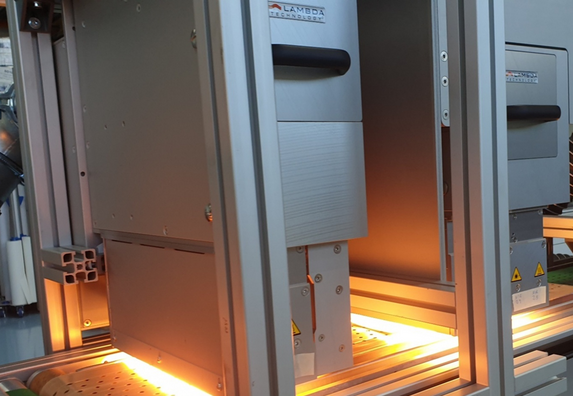
The drying of thin, functional layers is a critical process step in the value chain of fuel cells, electrolyzers, and batteries. Within the funded “HyDry” project, the Chair of Production Engineering of E-Mobility Components (PEM) of RWTH Aachen University, in collaboration with Lambda Technology GmbH, is researching hybrid drying technologies and developing models to support the transition from stationary to continuous measurement results.
Introduction to the HyDry Project
The goal of the “HyDry” project is to investigate hybrid drying technologies, combining infrared and convection drying, for applications in fuel cells, electrolyzers, and batteries. The project is a joint effort between the Chair of Production Engineering of E-Mobility Components (PEM) of RWTH Aachen University and Lambda Technology GmbH.
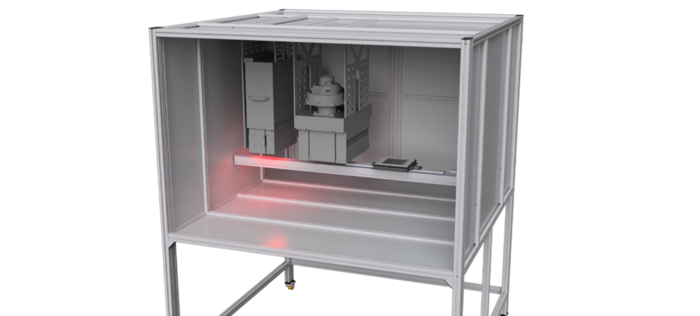
Mechanical Setup of the Test Stand
To conduct the experiments, a test setup is required, incorporating two drying modules – an infrared dryer and a convection dryer – as well as the substrate to be dried. Additionally, an infrared camera is integrated to evaluate the drying homogeneity of the substrate. For fuel cells and electrolyzers, the substrate consists of a coated membrane or a PTFE-based decal foil, while for batteries, it is an aluminum or copper foil. The substrates are placed on a linear unit equipped with a vacuum table to securely fix them in place.
Calculation Models for Scaling Stationary Tests
The factors influencing the drying process of fuel cells, electrolyzers, and batteries are highly complex. While individual processes can be described using formulas, determining precise relationships between process parameters and resulting quality parameters with a purely theoretical model is challenging. To address this, the project is developing a calculation method to derive correlations between process parameters and quality parameters. During the drying process, extensive process data is recorded and compared with the quality parameters determined post-drying using the developed method. These calculation models enable the straightforward scaling of measurements from stationary tests to continuous processes, facilitating more cost-effective industrialization efforts.
For more information about the project, visit:
Downloads
Hier informieren wir regelmäßig über alle wichtigen Entwicklungen im Bereich des Wasserstoffs, der Brennstoffzelle und des Elektrolyseurs.
Whitepaper: In-line Viscosity Measurement
Download a white paper on innovative solutions in the areas of real-time process monitoring and quality assurance
