
Hydrogen as a Pillar for Decarbonization of the Steel Industry
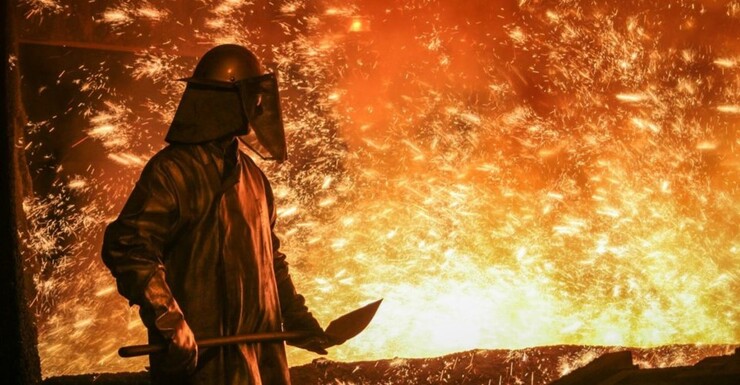
The steel industry is currently responsible for around 30% of industrial CO2 emissions. In order to become more climate-friendly in the future, research is currently being carried out into steel production using hydrogen. Within this article the "Fuel Cell Compass" gives insight into the possible processes, their function and the current challenges.
32% of all related emissions are process-related and 68% indirectly through energy consumption
At present, steel is largely produced using the blast furnace process, whereby a large amount of carbon dioxide is emitted due to the combustion of coke. The proportion of these process-related emissions is 32%. The remaining 68% of emissions in the steel industry are attributable to energy consumption, as most of the energy is obtained from fossil fuels. The use of hydrogen in the steel industry can save up to 28 tons of CO2 per ton of green hydrogen used.
Besides the use of the blast furnace process, the two additional most common processes for steel production in Germany are the direct reduction process and the electric arc process, Figure 1.
Figure 1: Process for steel production (Source: Weigel, 2014)
Blast furnace:
The blast furnace process is currently the most commonly used method for the primary production of steel in Germany. In this process, molten pig iron is extracted from iron ore in the blast furnace and then converted into crude steel. The iron ores must first be prepared by sintering and pelletizing before they are mixed with coal in the blast furnace. Oxygen is extracted from the iron ore using blast furnace coke to produce crude steel. Currently, 300 kg of coke and 200 kg of pulverized coal are used to produce one tonne of pig iron. In the future, hydrogen could be blown into the blast furnace as a reducing agent instead of blast furnace coke. This would make it possible to reduce CO2 emissions by up to 20%. However, this process is dependent on the effect of the coke, which is why a complete replacement with hydrogen is not possible.
Direct reduction process:
Another process for steel production is the direct reduction process. In this process, pellet-shaped iron ores are reduced in a shaft furnace. The process takes place at lower temperatures, which means that the iron is always solid. Sponge iron is produced, which is then further processed into steel in an electric arc furnace. The advantage of this process is that the raw material does not have to be prepared, which means that less energy is consumed and less CO2 is emitted.
The direct reduction process includes several processes that differ in the type of furnace used. In recent years, the direct reduction process has mainly been used with natural gas. These include fixed-bed processes such as the Midrex and Energion processes. In the Midrex process, lump ores or pellets are reduced in a shaft furnace. The reduction gas used is currently natural gas, which is converted in a reformer. After reduction, the iron ore is turned into sponge iron, which is processed into steel in an electric arc furnace.
Research is currently being carried out into the use of hydrogen in direct reduction. Carbon monoxide and hydrogen are used as the reducing gas instead of natural gas. To bridge the gap until sufficient hydrogen is available, it is also possible to combine the gases and use them in different proportions as reducing gas. When hydrogen is used, hydrogen reacts with the oxygen in the iron ore, producing sponge iron and water. The sponge iron can then be melted down in an electric arc process and processed into crude steel. This process produces 95% less CO2 emissions. The process is visualized in Figure 2.
Headline
Lorem ipsum dolor sitope amet, consectetur adipisicing elitip. Massumenda, dolore, cum vel modi asperiores consequatur suscipit quidem ducimus eveniet iure expedita consecteture odiogil voluptatum similique fugit voluptates atem accusamus quae quas dolorem tenetur facere tempora maiores adipisci reiciendis accusantium voluptatibus id voluptate tempore dolor harum nisi amet! Nobis, eaque. Aenean commodo ligula eget dolor. Lorem ipsum dolor sit amet, consectetuer adipiscing elit leget odiogil voluptatum similique fugit voluptates dolor. Libero assumenda, dolore, cum vel modi asperiores consequatur.
Downloads
Hier informieren wir regelmäßig über alle wichtigen Entwicklungen im Bereich des Wasserstoffs, der Brennstoffzelle und des Elektrolyseurs.
Whitepaper: In-line Viscosity Measurement
Download a white paper on innovative solutions in the areas of real-time process monitoring and quality assurance
