
Hydrogen Refueling Project GOLIAT Launched
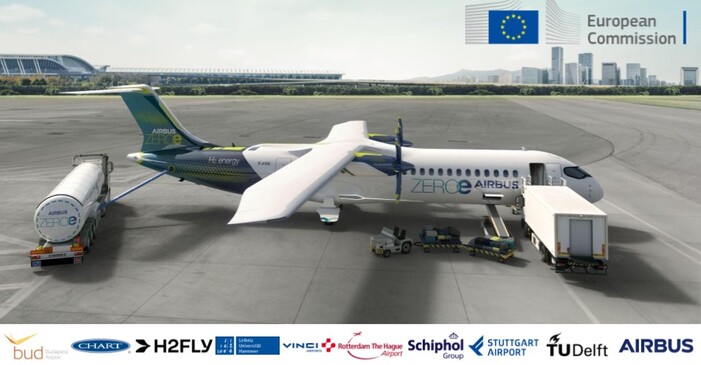
A new aviation hydrogen handling and refueling initiative, led by Airbus and supported by academic institutions, airport operators, and major hydrogen industry companies, has been launched. The project aims to demonstrate small-scale liquid hydrogen aircraft ground operations at three European airports.
European Consortium to develop LH2 transportation and storage solutions
The initiative, named GOLIAT (Ground Operations of Liquid Hydrogen Aircraft), will receive €10.8 million in funding from the EU’s Horizon Europe Framework Programme over four years. The project focuses on developing and demonstrating high-flow liquid hydrogen (LH2) handling and refueling technologies for safe and reliable airport operations.
The GOLIAT consortium includes 10 partners from eight countries: Airbus (France, Germany, UK), Chart Industries (Czech Republic, Italy), TU Delft (Netherlands), Leibniz University Hannover (Germany), Royal Schiphol Group (Netherlands), Rotterdam The Hague Airport (Netherlands), Vinci Airports (France, Portugal), Stuttgart Airport (Germany), H2FLY (Germany), and Budapest Airport (Hungary).
The project will support the aviation industry's adoption of LH2 transportation and energy storage solutions by:
- Developing and demonstrating LH2 refueling technologies scaled up for future large commercial aircraft.
- Demonstrating small-scale LH2 aircraft ground operations at airports.
- Developing the standardization and certification framework for future LH2 operations.
- Assessing the sizing and economics of hydrogen value chains for airports.
Repesentetives highlight the importance of reaching the project's goals
LH2 is considered a promising solution for reducing greenhouse gas emissions in aviation due to its clean and efficient nature. The project's goals include understanding the operational, regulatory, economic, and safety impacts of hydrogen use at airports, as well as evaluating the capacity and performance of associated technologies.
Karine Guenan, Vice President of ZEROe Ecosystem at Airbus, emphasized the potential of hydrogen as a fuel for short-haul aviation and the importance of building the operating case for its widespread use at airports. Josef Kallo, co-founder and CEO of H2FLY, highlighted the significance of leveraging experience from previous projects to support the GOLIAT initiative and the broader goal of decarbonizing aviation. Other representatives similarly expressed their enthusiasm and the importance of the initiative for the industry.
Hydrogen can be an enabler for sustainable aviation
Hydrogen offers high specific energy per unit mass, making it an efficient alternative to traditional jet fuel. When produced from renewable energy through electrolysis, it emits no CO2, enabling large aircraft to travel long distances without carbon emissions. Future aircraft designs will likely change to accommodate hydrogen storage solutions, which are bulkier than current jet fuel tanks. Hydrogen has long been used safely in aerospace and automotive industries, and the challenge now is to adapt it for commercial aviation. Hydrogen can be used in two main ways:
- Hydrogen Propulsion: Through modified gas-turbine engines or fuel cells, hydrogen can power hybrid-electric propulsion systems.
- Synthetic Fuels: Hydrogen can be converted into e-fuels, created using renewable energy sources.
The GOLIAT project aims to support the integration of hydrogen into aviation, supporting the sustainable aviation of the future.
Source
Downloads
Hier informieren wir regelmäßig über alle wichtigen Entwicklungen im Bereich des Wasserstoffs, der Brennstoffzelle und des Elektrolyseurs.
Whitepaper: In-line Viscosity Measurement
Download a white paper on innovative solutions in the areas of real-time process monitoring and quality assurance
