
Pilot Hydrogen Network under Operation ("TransHyDE")
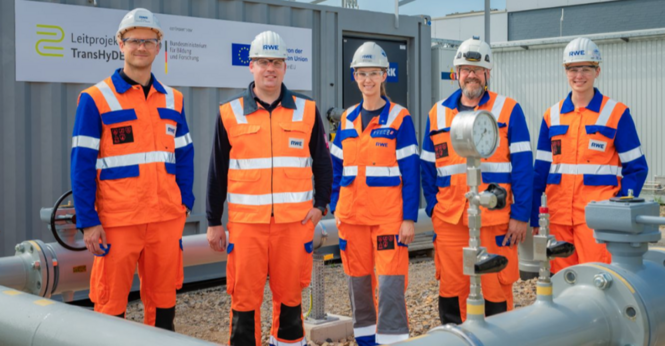
A pilot hydrogen network has been established to test key pipeline technologies that are still under development. The TransHyDE project has successfully launched this pilot network, spanning 130 meters, on the RWE company grounds in Lingen. Over the coming months, the project will assess various technologies crucial for the future hydrogen transport network in Germany.
Lead project for adressing challenges in the installation of a comprehensive hydrogen pipeline network
The German government aims to have around 9,700 kilometers of hydrogen pipelines operational by 2032, with 60% of these pipelines expected to be repurposed from existing natural gas lines. However, many components required for this network are still in the testing phase necessary for approval. The TransHyDE project seeks to address this by conducting practical tests on five specific pipeline technologies within this pilot network.
The technologies being tested include:
- Measurement technology for determining hydrogen quality
- Devices for measuring hydrogen flow rates
- Hydrogen purification technologies
- Inspection technologies for hydrogen networks
- A test stand for evaluating material compatibility with hydrogen
These tests are designed to provide insights into how hydrogen interacts with various materials and affects both new and existing pipelines. The project is also testing a gas chromatograph system to measure the purity of hydrogen within the pipeline, as well as a container system for purifying hydrogen to different levels, depending on its intended industrial use. For instance, the steel industry can utilize standard pipeline hydrogen, whereas the semiconductor industry requires highly purified hydrogen.
Test stands for anticipation of long-term effects on the pipeline network
To enable accurate tracking and billing of hydrogen flow between network operators and customers, flow measurement devices are also being put to practical tests. The project involves several partners, including Adlares, DVGW ebi (which coordinates the project), the University of Potsdam, Evonik, Meter-Q Solutions, Nowega, OGE, Rosen, and RWE.
Additionally, TransHyDE is using a test stand to study the impact of hydrogen at high temperatures on different materials. The project is also exploring future components of the transport network, such as the potential use of helicopters equipped with detection devices to identify small leaks from the air, similar to those used in the natural gas network. These detection technologies, including lasers, will be tested in a laboratory setting for safety reasons. Lastly, the project is testing a "pig" device designed to inspect and clean the interior of pipelines efficiently.
Source
Downloads
Hier informieren wir regelmäßig über alle wichtigen Entwicklungen im Bereich des Wasserstoffs, der Brennstoffzelle und des Elektrolyseurs.
Whitepaper: In-line Viscosity Measurement
Download a white paper on innovative solutions in the areas of real-time process monitoring and quality assurance
