
Quest One Opens New Gigahub in Hamburg for Electrolysis Stack Production
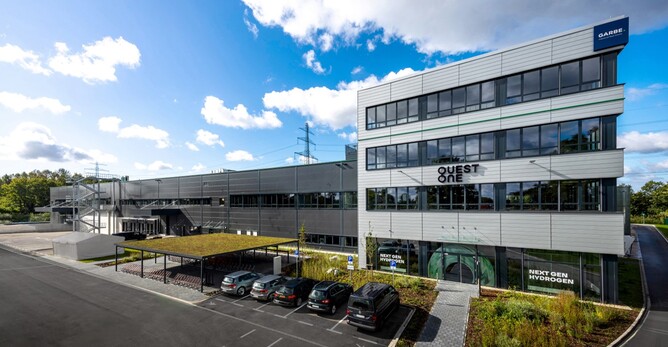
Quest One, formerly known as H-TEC SYSTEMS, has launched its new "Gigahub" in Hamburg, marking the start of serial and automated production of electrolysis stacks, key components in the production of green hydrogen. The facility's opening was attended by prominent political figures, including Federal Chancellor Olaf Scholz, Hamburg's First Mayor Dr. Peter Tschentscher, and executives from Quest One and MAN Energy Solutions.
More than 800 guests celebrated the opening
The series production of electrolysis stacks at the "Gigahub" shall offer the necessary products in order to increase the availability of green hydrogen. More than 800 guests, including government officials and business leaders, attended the event, emphasizing the significance of the hydrogen economy in Germany’s energy transition. Federal Chancellor Scholz commented on the potential impact of the facility, highlighting the shift from manual to automated production, which is expected to reduce manufacturing time by 75%. Hamburg's Mayor Dr. Peter Tschentscher noted the role of green hydrogen in supporting both the energy transition and the competitiveness of German industry.
Automated series production of PEM electrolysers
The new facility will focus on PEM (proton exchange membrane) electrolysis technology, which is one of the primary methods for large-scale hydrogen production from renewable sources. The automated production of these stacks would represent a major step forward in making green hydrogen more accessible, with applications in industries requiring high energy consumption. Quest One would aim to contribute to global efforts to reduce greenhouse gas emissions. The company would plan to avoid one percent of global emissions by 2050 through its electrolysis technology.
Maximum production capacity of over five gigawatts per year
The Gigahub’s production capabilities will eventually reach an electrolysis capacity of over five gigawatts per year. The highly automated production system would use advanced robotics, reducing production time and enhancing efficiency and quality. The facility would have been developed with sustainability in mind, featuring green roofs and a photovoltaic system, and is pursuing Platinum certification from the German Sustainable Building Council. The project, funded in part by the Federal Ministry of Education and Research’s H2Giga initiative, is part of broader efforts to industrialize hydrogen production in Germany.
Source
Downloads
Hier informieren wir regelmäßig über alle wichtigen Entwicklungen im Bereich des Wasserstoffs, der Brennstoffzelle und des Elektrolyseurs.
Whitepaper: In-line Viscosity Measurement
Download a white paper on innovative solutions in the areas of real-time process monitoring and quality assurance
