
Status of the Hydrogen Refueling Station Infrastructure
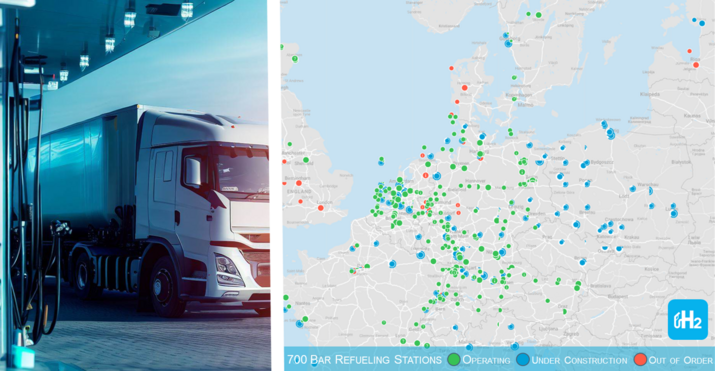
An intact hydrogen infrastructure is one of the core preliminaries for a successful implementation of hydrogen vehicles. Anyhow, the distribution of refueling stations across Europe is still differing. Furthermore, not all stations are capable of achieving and refueling hydrogen in all existing forms. Further need for action is needed - especially for heavy duty trucks and liquid hydrogen.
Hydrogen solutions for long-distance applications are necessary in order to achieve the climate targets
In the face of climate change, CO2 emissions must be reduced across all sectors. According to the Federal Environment Agency from 2022, the transport sector emits 20% of German greenhouse gas emissions. Around 36% of these come from trucks and around 61% from cars. Suitable solutions are needed to reduce these emissions. As far as possible, no compromises should be made with regard to customer requirements. The most established solution today is the electrification of the vehicle drivetrain.
There are two different concepts, the battery electric drive and the fuel cell electric drive. The battery-electric drivetrain consists of a traction battery that acts as an energy storage unit, an inverter that converts the direct current provided by the battery into alternating current, and an electric motor that converts the alternating current into mechanical power. The fuel cell-electric drivetrain supplements this concept with a hydrogen tank for storing the hydrogen as an energy source and a fuel cell for electrochemically converting the hydrogen into electrical energy. The traction battery is generally small due to the power provided by the fuel cell, as only small amounts of energy are required to compensate for peak loads.
With regard to the choice of drive concept, it is worth taking a look at the respective energy storage systems. Lithium-ion batteries now achieve energy densities of over 0.27 kWh/dm3. In contrast, hydrogen storage systems can achieve energy densities of up to 2.3 kWh/dm3 (subcooled liquid hydrogen (sLH2)), depending on the concept, but require large cylindrical tanks. The packaging of hydrogen tanks poses a particular challenge for passenger cars. This conflicting package objective is complemented by the rapid refueling capability of hydrogen tanks. This concept is therefore ideal for long-distance applications, while battery-electric drives are preferred for local transportation.
Different storage systems exist in automotive applications
With regard to storage in mobile systems, the focus is currently on two technologies that have been implemented in three systems. These were discussed in detail in the following article, among others (see Article). The storage of sLH2 for truck applications is currently being promoted by Daimler Truck and the first truck is already on German roads. Series production is due to start in the second half of this decade.
Daimler Truck has developed a filling station standard with Linde to provide the liquid hydrogen. The first hydrogen filling station built to this standard is scheduled to go into public operation in mid-2024. In addition to storing liquid hydrogen in the vehicle, it can also be stored under pressure in gas tanks. There are two standard pressures for tanks, the 700 bar standard and the 350 bar standard. The 700 bar standard is currently established for passenger cars in particular, as it enables a higher energy density relative to the 350 bar standard (1.3 kWh/dm3 - 700 bar; 0.8 kWh/dm3 - 350 bar).
At the same time, the provision of more highly compressed hydrogen is more expensive. Hydrogen tanks in commercial vehicles are generally approved for 350 bar, as the installation space is available and operating costs are the main consideration. Quantron and Nikola/IVECO, who have independently presented fuel cell-electric tractor units with 700 bar hydrogen tanks, show that this is not always the case.
Different refueling stations infrastructures exist depending on the use case
But how does the hydrogen get into the tanks of the vehicles? As with conventional diesel, there are filling stations for refueling. These differ in terms of the aggregate state of the refilled hydrogen. For example, when refueling with liquid hydrogen, it must be ensured that it remains liquid during the refueling process. In addition, the hydrogen must either be kept in liquid form or liquefied during refueling. The same applies to the provision of gaseous hydrogen. This must either be stored above the target pressure or compressed during refueling.
The refueling process itself poses a challenge here. As the gaseous hydrogen is fed into the tank through a pressure gradient and hydrogen heats up during decompression, it must either be additionally cooled and the temperature of the tank monitored (or the tank itself) must be cooled if necessary. Sufficient compressed hydrogen must also be available. This is particularly relevant at 700 bar.
The filling station infrastructure is growing - but still lacking maturity
As with battery electric vehicles, the expansion of the filling station infrastructure is closely linked to the establishment of the vehicles. There are currently 170 publicly accessible hydrogen filling stations with 700 bar capability in operation in Europe, with a further 46 under construction. Fot 350 bar capacity ,there are currently 82 filling stations in operation and a further 71 under construction.
Filling stations for liquid hydrogen, as well as vehicles that require this standard, are currently not available. The expansion and operation of hydrogen filling stations is currently heavily subsidized. This serves, among other things, to solve the Henn's egg problem of technology introduction.
Nevertheless, there is still a need for action here. The same applies to the provision of hydrogen at filling stations. The aim here is to be able to provide green, CO2-neutral hydrogen in the long term. However, this is currently not the case everywhere. The hydrogen can be transported from the producer to the filling station by pipeline or truck trailer. Due to the currently very small number of vehicles, demand planning and supply are no easy task.
Source
Daimler Truck Hydrogen Record Run
Bundesamt für Umwelt, Naturschutz und nukleare Sicherheit: Klimaschutz in Zahlen - Fakten, Trends und Impulse deutscher Klimapolitik (June 2021)
Manfred Klell, Helmut Eichlseder, Alexander Trattner: Wasserstoff in der Fahrzeugtechnik: Erzeugung, Speicherung, Anwendung (2018)
Downloads
Hier informieren wir regelmäßig über alle wichtigen Entwicklungen im Bereich des Wasserstoffs, der Brennstoffzelle und des Elektrolyseurs.
Whitepaper: In-line Viscosity Measurement
Download a white paper on innovative solutions in the areas of real-time process monitoring and quality assurance
