
The Energy Transitions and an H2 Core Grid are a Joint Task
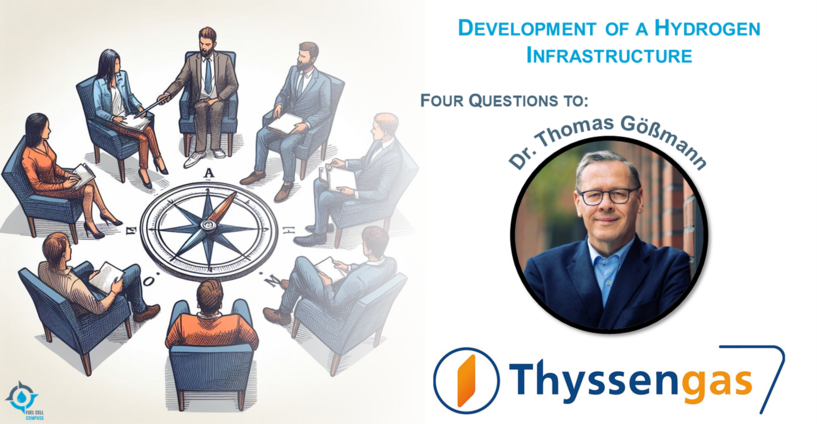
While different opinions about use cases of hydrogen exist, the need for the construction of a respective infrastructure is less controversial. The current status for Germany, challenges, and chances are set into context by Dr. Thomas Gößmann, Chairman of Thyssengas.
Fuel Cell Compass: What are you involved with in the world of hydrogen and in which business areas are you active?
Dr. Thomas Gößmann: After more than 30 years in the energy industry following my studies and doctorate at RWTH Aachen University, I am currently working on the development of a transport infrastructure for hydrogen, particularly in North Rhine-Westphalia and Lower Saxony, as an engineer and Chairman of the Management Board of the transmission system operator Thyssengas. For the energy transition and thus the switch to hydrogen and other green gases to succeed, the first step is a pipeline network that transports the hydrogen to where it is needed. This is where we at Thyssengas come in. With a view to security of supply and achieving climate targets, we are working to ensure that hydrogen and other green gases can flow through our 4,400-kilometre-long pipeline network in the near future. Where natural gas still predominantly flows today, hydrogen will be transported tomorrow. That is why we are gradually converting our existing pipelines to H2 transport in the coming years and building new pipelines where necessary. The centerpiece of a Germany-wide hydrogen infrastructure is the hydrogen core network – also known as the “hydrogen highways”. We are designing and planning this basic framework of the H2 infrastructure in close collaboration with the other transmission system operators, TSOs. We want to realize this approximately 9,700-kilometre-long H2 core network by 2032. I have also been Chairman of our industry association, the Association of Gas Transmission System Operators, FNB Gas, since 2020. The H2 market ramp-up is a joint task.
FCC: How do you assess the role of hydrogen as an energy source in the coming decades?
Gößmann: Hydrogen is widely seen as the energy source of the future. It can contribute to security of supply in Germany and accelerate the industry’s decarbonization. The potential is huge: According to an IW study, the Ruhr region alone – the home of Thyssengas – could save up to 25.5 million tonnes of carbon dioxide per year outside the energy industry if consistent investment in hydrogen is made in the coming years. Also, industry is H2-ready: Many companies in North Rhine-Westphalia are planning to switch their energy-intensive processes to hydrogen in the near future. The aim must therefore be to ensure that hydrogen reaches companies as quickly as possible with the right and safe infrastructure and that we solve this chicken-and-egg problem.
FCC: How do you assess the current status of the hydrogen core network in Germany? Will the necessary distribution structures be available in time?
Gößmann: In my view, 2024 is a landmark year for the hydrogen ramp-up and the H2 core network. In recent months, we have already been able to set a decisive course: In November 2023, we transmission system operators submitted the draft application for the H2 core network. That was a milestone. The final planning and approval stage are now imminent: In May 2024, we TSOs are required to submit the final application for the H2 core grid to the Federal Network Agency for approval. However, the outstanding financing issues still need to be clarified. It is a fact: Without a secure financing model for the H2 core network, there will be no hydrogen future. Only with a financing model that reflects the entrepreneurial risks involved in developing this entirely new market and which proves to be capital market-capable can the timely realization of the hydrogen core network begin. We must not waste any more time at this point in planning and clarifying the financing, because the timetable for the actual realization, construction, and commissioning is tight. A maximum of eight years is not much for infrastructure projects of this size. It is therefore necessary to speed up and standardize planning and approval procedures in order to meet the politically stipulated timetable. Nonetheless, I am confident that we can keep to the schedule and provide the necessary distribution structures on time – if all stakeholders work closely together with the politicians.
FCC: Where do you see the greatest challenges to mastering the energy transition? How can we overcome them as an industry?
Gößmann: The transformation from fossil fuels to green gases such as hydrogen is the opportunity of the century – but it also harbors major challenges, no question about it. Politics, industry, and research must create a completely new market – this requiring a regulatory framework, the development of standards for the safe transport and storage of hydrogen, and the creation of incentives for investment in hydrogen technologies. In addition to the hydrogen infrastructure, it must also be ensured, for example, that the production of hydrogen from renewable sources such as wind and solar energy can be scaled up sufficiently. In order to master this mammoth task, we need to focus on collaboration and dialogue on an equal footing. The energy transition, including the H2 core grid, is a joint task. In my view, a rapid H2 ramp-up requires, above all, political tailwind, social acceptance, transparent and reliable regulation, and collaboration as the basis for success of the energy transition. We transmission system operators can build the hydrogen core network – but we can only achieve the green transformation together.
Downloads
Hier informieren wir regelmäßig über alle wichtigen Entwicklungen im Bereich des Wasserstoffs, der Brennstoffzelle und des Elektrolyseurs.
Whitepaper: In-line Viscosity Measurement
Download a white paper on innovative solutions in the areas of real-time process monitoring and quality assurance
