The Investment Paradox in Hydrogen Technologies
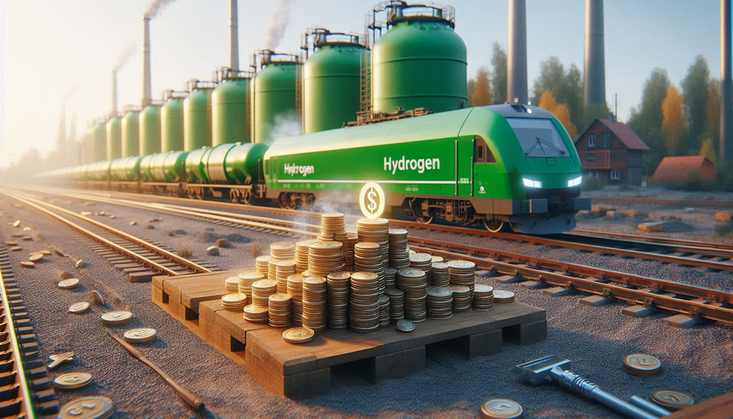
Hydrogen is a vital component on the path to climate neutrality. Deploying green hydrogen across various industries can serve as a viable strategy for transitioning our energy system to the storage and utilization of renewable energy. However, parallel to the ambitious expansion of renewable energy generation, a significant scaling up of the global hydrogen infrastructure will be essential.
Exact figures for the electrolysis capacity required by 2050 vary widely, but one thing is clear: the electrolysis capacity needs to be substantially increased. In its scenario for Net Zero 2050, the International Energy Agency (IEA) states a required total electrolysis capacity of 3,585 GW. The International Renewables Energy Agency (IRENA) goes even further in its pathway for maintaining the 1.5 °C target and defines a required electrolysis capacity of 5,000 GW by 2050. For comparison: in 2023, the total output of installed electrolyzers worldwide exceeded 1 GW. Figure 1 shows a comparison of possible designs of the IRENA and IEA scenarios. While the exact capacities may vary, it is clear that a huge expansion of hydrogen technologies is essential for a green energy transition.

The Investment Paradox in Hydrogen Technologies
Despite a growing political consensus around hydrogen deployment, particularly in European climate governance, actual investment decisions still remain significantly behind global net-zero scenarios. This paradox emerges from a complex interplay of financial, technological, regulatory, and market factors, collectively creating a high-risk investment environment.
As a result, the hydrogen economy finds itself caught in a tough spot where strategic importance clashes with investment hesitancy. While governments worldwide acknowledge hydrogen’s potential, the private capital necessary for large-scale deployment largely remains on the sidelines.
Financial Barriers: The Risk-Return Imbalance
The financial barriers to hydrogen investments may well be the most significant impediment to private-sector participation. Current hydrogen technologies face unfavorable economics, characterized by high upfront capital requirements and long payback periods. Studies examining potential returns for automobile enterprises entering the hydrogen fuel cell commercial vehicle market present discouraging financial projections. For companies with considerable market presence and strong brand value, the Dynamic Payback Period of Investments (DPPI) can exceed 17 years—an exceptionally long timeframe even for infrastructure ventures. Notably, even more established automotive firms with robust technological foundations still grapple with extended payback periods.
Uncertain profitability in hydrogen infrastructure is another critical challenge. Research employing Monte Carlo simulations to assess investment strategies for hydrogen refueling stations indicates that under current market conditions, the probability of achieving profitability stands at just 38.9%. This represents an unacceptably high-risk profile for private investors seeking reliable returns. Moreover, the substantial technical costs of building hydrogen refueling infrastructure further exacerbate these financial hurdles, making the risk-return balance significantly less attractive than other investment options.
Risk perception is an additional obstacle. Green hydrogen projects involving electrolyzers and fuel cells face uncertain future electricity prices, introducing volatility into operational cost estimates. This inherent risk profile discourages involvement from traditional financial institutions that typically prioritize stable, predictable returns.
Regulatory Uncertainty and Market Structure Inefficiencies
The regulatory environment surrounding hydrogen technologies still lacks the clarity and stability necessary to attract substantial private investment. While many governments have articulated hydrogen strategies, the specific policy frameworks, incentive structures, and regulatory standards often remain underdeveloped or inconsistent across different jurisdictions. This regulatory uncertainty causes hesitation among potential investors, who require clear, long-term policy frameworks to justify capital allocation to emerging technologies. In the absence of established climate targets, market design parameters, and liability regimes, private investors face added regulatory risks that further skew the risk-return equation.
Equally significant is the lack of international standards for hydrogen production, transportation, and utilization. Without standardized regulations covering safety criteria, quality specifications, and cross-border transportation, companies risk investing in technologies and infrastructure that may later prove incompatible with newly emerging standards. This standardization gap heightens both the perceived and actual risks linked to hydrogen investments, particularly for projects with international dimensions or those reliant on global supply chains.
Material availability and associated cost policy
A considerable share of contemporary hydrogen technologies requires substantial amounts of critical raw materials. Notable examples include the platinum group metals used in proton exchange membrane fuel cells and electrolyzers, as well as the carbon fiber–reinforced plastic needed for compressed hydrogen storage tanks. The intersection of high raw material demand and limited availability increases the investment risk for infrastructure expansion.
Material availability also depends heavily on the regulatory environment. Possible bans on specific substances—such as the proposed European ban on PFAS (per- and polyfluoroalkyl substances)—could undermine core component functionality and hinder overall technology deployment. Although initial updates from ECHA (European Chemicals Agency) may exempt PFAS for use in fuel cells and electrolyzers, these regulatory developments can still introduce considerable uncertainty into the market.
Financial Innovation and Risk Management Approaches
Innovative financial structures hold substantial potential for mobilizing private capital in hydrogen technologies. Green Investment Banks (GIBs) and specialized financing groups can bridge the gap between traditional investment requirements and the elevated risk profile of hydrogen projects. By strategically deploying public capital to absorb specific risks that private investors typically find unacceptable, these institutions can catalyze additional private investment. Through credit enhancements, subordinated debt, and other risk-sharing mechanisms, these financial intermediaries can significantly boost the appeal of hydrogen projects.
Risk management via portfolio diversification and staged investment approaches can also help address the existing barriers. Rather than treating hydrogen investments in isolation, integrating them into broader energy transition portfolios enables investors to balance risks across multiple technologies and markets. Moreover, staged investment strategies—where capital deployment escalates as technologies mature and market conditions improve—can help mitigate the persistent uncertainties currently tied to hydrogen technologies.
Technological Advancement and Cost Reduction Pathways
Accelerating technological advancement is a critical strategy for strengthening the investment case for hydrogen technologies. Current research focuses heavily on developing noble-metal-free catalysts for proton exchange membrane (PEM) fuel cells and electrolyzers. Similar efforts target improvements in hydrogen storage, transportation, and utilization technologies, all with the goal of enhancing efficiency while reducing both capital and operating costs.
Reducing costs through economies of scale and learning effects offers another promising route to boosting investment appeal. As deployment expands, per-unit production costs typically decline through gains in manufacturing efficiency, supply chain optimization, and operational know-how.
Integrating hydrogen technologies into existing energy systems can further improve overall economics while providing valuable grid services. Research examining hydrogen and battery storage solutions for cost-efficient decarbonization in distribution networks illustrates how hydrogen electrolyzers can function as utility-controllable loads, helping to manage grid variability and produce hydrogen for diverse applications.
By adopting circular methods such as the “R-strategies” to decrease reliance on critical and costly raw materials, the total expense of technological deployment can be further reduced. The hydrogen sector can also incorporate circular economy principles by embracing the “Product as a Service” model.
Bridging this investment gap calls for coordinated action across multiple domains
The persistent gap between hydrogen’s strategic importance and actual private-sector investment underscores a complex interplay of financial, technological, regulatory, and market barriers. Current hydrogen technologies present an unfavorable risk–return profile characterized by high capital costs, extended payback periods, technological uncertainties, and regulatory ambiguities. Although political rhetoric increasingly highlights hydrogen’s central role in decarbonization pathways, the conditions needed to attract substantial private capital remain underdeveloped.
Bridging this investment gap calls for coordinated action across multiple domains. Policy measures must provide clear, stable regulatory frameworks and introduce suitable de-risking mechanisms to improve the appeal of hydrogen investment. Financial innovation through specialized investment vehicles and risk-sharing structures can help align investor requirements with the unique attributes of hydrogen projects. Meanwhile, technological progress focused on cost reduction and performance improvement will steadily reinforce the underlying economics of hydrogen-based solutions. Finally, staged deployment strategies leveraging public–private partnerships can establish the initial market scale necessary to trigger positive feedback loops of increasing investment and decreasing costs.
While the path to a hydrogen economy remains challenging, the combination of climate imperatives, strategic energy security considerations, and technological advances suggests that private-sector investment will ultimately accelerate—provided the right enabling conditions are in place. As technologies mature, sales volumes increase, and R-strategies are judiciously applied, both the costs and uncertainties associated with hydrogen technologies can be significantly reduced, ultimately making them a far more attractive prospect for private investors.
Source:
Hydrogen Council (Hydrogen Insights Dececmber 2023) 2023: 1 GW-Marke wurde überschritten
IEA (Net Zero by 2050) 2021: IEA-Szenario des Hochlaufs der EL-Leistung
IRENA (World Energy Transitions Outlook) 2022: IRENA-Szenario des Hochlaufs der EL-Leistung
Hunt & Tilsted (‘Risk on steroids’: Investing in the hydrogen economy) 2024: Gründe der geringen Investments
Yuan (Investment Income Analysis of Automobile Enterprises Entering the Commercial Vehicles Field of Hydrogen Fuel Cell) 2022: DPPI für Autobauer
Chen et al. (Research on the investment strategy of hydrogen refueling stations based on Monte Carlo simulation) 2023: Monte Carlo Analyse für die Investitionssicherheit und den Infrastrukturaufbau
Agyekum et al. (A Critical Review of Renewable Hydrogen Production Methods: Factors Affecting Their Scale-Up and Its Role in Future Energy Generation) 2022: Regulatory Uncertainty and Market Structure Inefficiencies
Fuel Cell Compass (We expect to see the first substantial EoL material streams in the next 10 to 15 years) 2025: R-Strategien als Notwendigkeit des Martks
David et al. (A Comparative Study on the Role of Public–Private Partnerships and Green Investment Banks in Boosting Low-Carbon Investments) 2018: Finanzierungsmöglichkeiten von H2 durch öffentlich-private Partnerschaften
European Chemicals Agency (Progress update on the per- and polyfluoroalkyl substances (PFAS) restriction process, 20 November 2024), 2024: Mögliche Ausnahmen von FC und EL beim PFAS-Verbot
Walter et al. (Operating behavior of a photovoltaic-driven electrolysis system) 2024: Möglichkeit der kombinierten Verwendung von H2-Elektrolyse und Batterien
Downloads
Hier informieren wir regelmäßig über alle wichtigen Entwicklungen im Bereich des Wasserstoffs, der Brennstoffzelle und des Elektrolyseurs.
Whitepaper: In-line Viscosity Measurement
Download a white paper on innovative solutions in the areas of real-time process monitoring and quality assurance