
Vienna Transitions Challenging Line 39A to 100% Hydrogen Power
Vienna Transitions Challenging Line 39A to 100% Hydrogen Power
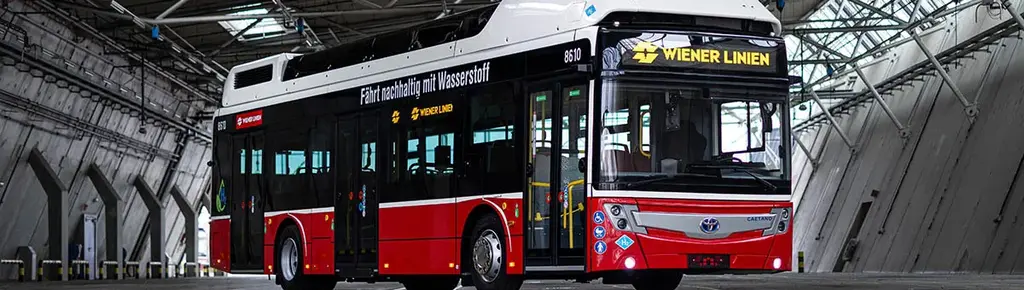
Taking a step toward decarbonizing its public transport network, Wiener Linien has announced that bus line 39A will operate exclusively with hydrogen fuel cell buses starting December 1, 2025. This marks the first time a complete bus route in the Austrian capital has been transitioned to hydrogen technology, signaling a shift in strategy for servicing the city's most topographically challenging routes.
The transition involves the deployment of ten "H2.City Gold" buses manufactured by the Portuguese company CaetanoBus. The 12-meter vehicles will service the route between Heiligenstadt and Sievering, a connection known for its steep inclines, short distances between stops, and high passenger volume.
A Test Case for Difficult Terrain The selection of line 39A for this rollout is strategic. While Wiener Linien has already integrated battery-electric buses into its fleet, hydrogen technology was specifically chosen for this route to address operational hurdles that pure battery-electric vehicles struggle to overcome without frequent recharging. The operator notes that the high energy density of hydrogen allows for stable performance on hilly terrain and a range of at least 400 kilometers, ensuring the buses can complete a full day's service without interruption.
“Line 39A is one of the most demanding lines in the city,” a spokesperson for the operator noted. The successful deployment here is intended to serve as a proof-of-concept for using hydrogen to decarbonize routes that are otherwise difficult to electrify.
Local Energy Ecosystem The initiative highlights a closed-loop approach within the Wiener Stadtwerke group. The green hydrogen powering the fleet is produced by energy provider Wien Energie using renewable electricity at the Smart Campus in Simmering. The refueling infrastructure is maintained by Wiener Netze at the Leopoldau bus depot. This synergy allows the city to control the entire value chain—from green energy production to public transit operation.
Technical and Financial Context The new fleet offers capacity for 78 passengers and utilizes fuel cell technology from Toyota. The project is part of a broader push by the city to achieve climate neutrality by 2040. The procurement was supported by funding from the European Union’s EBIN program and the Austrian Ministry for Climate Protection, underscoring the reliance on public subsidies to bridge the cost gap for nascent green technologies.
With this rollout, Vienna joins a growing list of European cities diversifying their zero-emission fleets, moving beyond a "one-size-fits-all" electrification strategy to a mixed model utilizing both battery and hydrogen solutions.
Source
Downloads
Hier informieren wir regelmäßig über alle wichtigen Entwicklungen im Bereich des Wasserstoffs, der Brennstoffzelle und des Elektrolyseurs.
Whitepaper: In-line Viscosity Measurement
Download a white paper on innovative solutions in the areas of real-time process monitoring and quality assurance
