
Airbus and MTU Aero Engines Collaborate on Hydrogen Fuel Cell Technology for Aviation
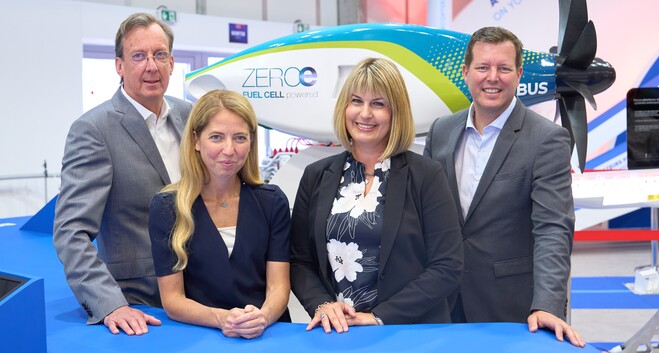
Airbus and MTU Aero Engines have signed a Memorandum of Understanding (MoU) to jointly advance the development of hydrogen fuel cell propulsion systems for aviation. The agreement was formalized at the 55th Paris Air Show by Bruno Fichefeux, Head of Future Programs at Airbus, and Dr. Stefan Weber, Head of Engineering and Technology at MTU.
Joint development process in three stages
The collaboration combines Airbus’ expertise in hydrogen-powered flight, notably through its ZEROe initiative, with MTU’s background in propulsion systems for civil and military aircraft. This follows Airbus’ decision to focus its research efforts on developing a fully electric, hydrogen-powered aircraft using fuel cell technology. MTU has contributed to this area with its "Flying Fuel Cell™" concept.
The development process is planned in three stages. First, the companies aim to advance key technologies through joint research efforts, such as those supported by the European Clean Aviation program. Second, they intend to align their respective R&D roadmaps in hydrogen propulsion. This may lead to a third phase: the potential development of a fuel cell propulsion system for a hydrogen-powered aircraft.
Complementation of individual competencies
“Our focus on all-electric fuel cell propulsion systems for future hydrogen-powered aircraft underlines our confidence and progress in this area,” said Bruno Fichefeux of Airbus. “The cooperation with MTU, a leading company in engine manufacturing and innovation, is a perfect complement to our own progress. [...]”
Dr. Stefan Weber of MTU emphasized the strategic importance of the partnership: “We are at the center of a broad ecosystem of partners aiming to fully electrify the powertrain through the use of fuel cell technology. The partnership with Airbus gives us the opportunity to jointly advance technological maturity and platform integration in equal measures. Our efforts over the next few years are the first step in paving the way for potential product development in the future.”
Ongoing individual research in the joint research field
Hydrogen is regarded as a promising long-term option for reducing emissions in aviation, with the potential to reshape the sector similarly to how electric vehicles have transformed road transport. Airbus aims to bring a hydrogen-powered commercial aircraft to the market. Launched in 2020, the company’s ZEROe project explores both hydrogen combustion and hydrogen fuel cell propulsion. In March 2025, Airbus announced it would focus on the latter following successful prototype and drivetrain testing, including research into supporting technologies like cryogenics.
In parallel, MTU Aero Engines continues to develop its hydrogen-based fuel cell propulsion concept. Recent progress includes finalizing the design of the Flying Fuel Cell™, initiating stack production for a demonstrator unit, conducting initial tests of an electric motor developed by eMoSys, and commissioning a new test facility in Munich. MTU also leads the Clean Aviation technology project HEROPS (Hydrogen-Electric Zero Emission Propulsion System), launched in early 2024. The initiative aims to develop innovative technologies for a climate-neutral, hydrogen-electric propulsion system that could power regional aircraft from 2035 onward.
Source
Photo caption
Signing of the MoU (from left to right): Dr. Stefan Weber (MTU), Marie-Eve Rigollet (SVP Propulsion System Procurement, Airbus), Claudia Gaab (MTU Strategy), and Bruno Fichefeux (Head of Future Programs, Airbus).
Downloads
Hier informieren wir regelmäßig über alle wichtigen Entwicklungen im Bereich des Wasserstoffs, der Brennstoffzelle und des Elektrolyseurs.
Whitepaper: In-line Viscosity Measurement
Download a white paper on innovative solutions in the areas of real-time process monitoring and quality assurance
