
Bosch Presents Sustainable Powertrain Solutions for Construction Machinery at bauma 2025
At the currently running bauma 2025 trade fair, Bosch highlights a range of technologies designed to reduce the environmental impact of construction machinery. As more than one million new construction vehicles are expected to be produced worldwide in 2025—most still powered by diesel engines—the company is focusing on ways to lower carbon emissions across both existing and future fleets.
Synthetic fuels as an immediate emissions reduction strategy
Bosch is promoting the use of renewable synthetic fuels, such as HVO100, as an effective means to reduce the carbon footprint of diesel-powered vehicles. These fuels are derived from residual and waste materials, offering lower lifecycle carbon emissions compared to fossil fuels. They are also compatible with existing diesel engines and infrastructure, making them a practical solution for immediate implementation. Bosch has already integrated compatibility with such fuels into its injection systems.
The company anticipates that diesel engines will continue to dominate the construction sector in the near future. By 2035, it projects that four out of five new construction machines with over 56 kilowatts of power will still rely on diesel. Accordingly, Bosch plans to continue advancing injection and exhaust-gas treatment technologies to improve efficiency and emissions performance.
Digital tools to track fuel sustainability
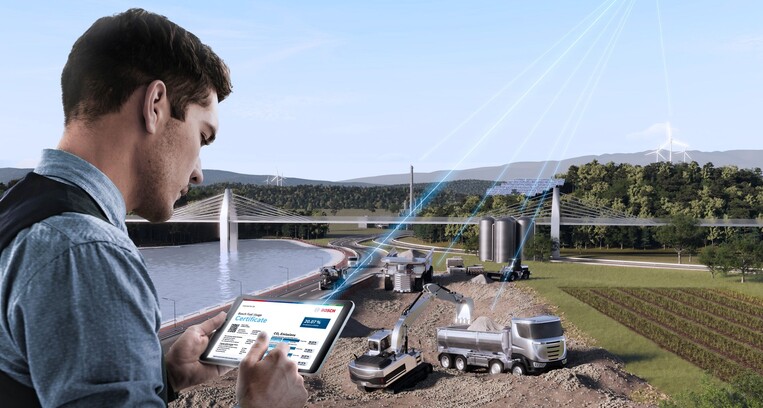
To increase transparency around fuel sustainability, Bosch has developed the "Digital Fuel Twin," a software-based solution that digitally tracks and certifies the use of renewable synthetic fuels. The tool documents fuel origin, distribution, and use, providing certificates that quantify carbon emissions and fuel consumption for individual vehicles. This data can support operators in meeting environmental standards and reporting requirements.
Advancing hydrogen technologiesAdvancing hydrogen technologies
Bosch is also advancing hydrogen engine technologies, which build on existing combustion engine platforms. The company states that up to 80–90% of components used in hydrogen engines can be sourced from conventional engine systems. When powered by hydrogen produced with renewable energy, these engines could provide a low-emission alternative, especially for heavy-duty and stationary applications. Bosch is developing both port and direct injection systems and is currently involved in over 100 hydrogen engine development projects worldwide. The first applications using Bosch injection technology are expected to launch later this year.
Hydrogen engines may be particularly suited to high-power applications such as mining trucks, where reliability, compact design, and fuel efficiency are critical.
Electrification expands in construction applications
In addition to synthetic fuels and hydrogen, Bosch is also exploring electrification for both mobile and stationary construction equipment. Its subsidiary, Bosch Rexroth, offers the eLION portfolio, which includes electric motors, inverters, gearboxes, software, and hydraulic components. The company is expanding its lineup to include components for 96-volt systems, with a unified software platform for all voltage classes scheduled for release by the end of 2025.
Bosch Engineering is also introducing a high-performance electric drive solution for battery systems up to 800 volts. This compact system offers high power density and is designed for construction machinery with limited space and high energy demands, such as wheel loaders.
Bosch at bauma 2025
Bosch, along with its subsidiaries Bosch Rexroth and Bosch Engineering, is currently presenting these powertrain and electrification solutions at bauma 2025. Attendees can visit the company’s exhibits at booths A3/327 and A4/526.
Source
Downloads
Hier informieren wir regelmäßig über alle wichtigen Entwicklungen im Bereich des Wasserstoffs, der Brennstoffzelle und des Elektrolyseurs.
Whitepaper: In-line Viscosity Measurement
Download a white paper on innovative solutions in the areas of real-time process monitoring and quality assurance
