
Coating processes for fuel cells and electrolyzers
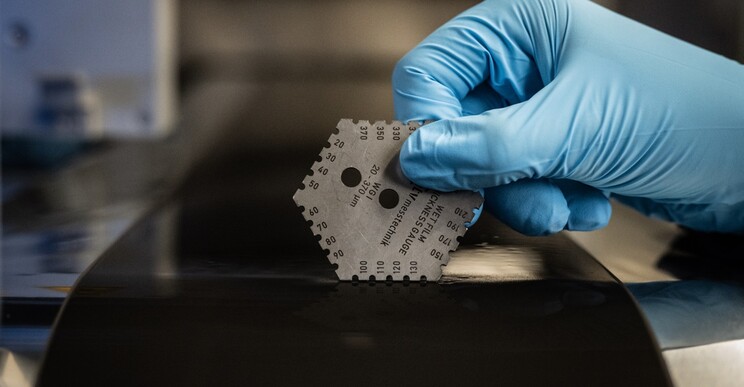
One of the most important process steps within the fuel cell and electrolyzer production is the coating of the membrane. A successful and homogenous coating is responsible for the resulting product efficiency and mistakes during that process step can heavily increase the production costs.
Multiple industrial coating approaches
A look at the market for coating technology in the field of fuel cells or electrolysis shows that there is not a sole technology that is used in industry and research. When observing the market, it can be summarized that the processes are characterized by the
- Application tool,
- the substrate and
- the type of process (batch production or continuous production).
The choice of the right application tool depends on several factors. For example, the individual technologies can be differentiated in terms of quality, flexibility, production quantity, costs, and degree of maturity. This means that other technologies are used in fundamental research compared to large-scale production.
Alternating solutions can also be used for the substrate. For example, the catalyst ink can first be applied to a transfer film and then transposed using a hot-pressing process (indirect process). As an alternative, the catalyst ink can also be applied directly to the membrane or the gas diffusion layer (fuel cell) respectively to the porous transport layer (electrolyzer, direct process). In the latter two processes, no further transfer step is required. Again, the choice of the substrate depends on the materials used and the experience of the manufacturing company. For example, applying the catalyst to the decal film is easier to process than applying it directly to the membrane. However, the application of the decal requires a subsequent hot-pressing process.
Continuous processes will prevail
In addition, the process can be described by the extent to which it is discontinuous (batch production) or continuous (roll-to-roll process). Many batch productions are still used today, which can be explained by the current market situation. However, with further market ramp-up and an increasing expansion of production capacities, it can be expected that continuous processes will prevail in large-scale production in the long term. Therefore, line speeds of about 10 m/min are targeted in the industry.
Figure 1 shows examples of technologies that are currently being used in demonstration or series production plants. With a view to possible large-scale production, these therefore differ in terms of the application tool and the substrate.

Figure 1: Overview of different coating technologies for fuel cells and electrolyzers
Further process alternatives are under investigation
Several other processes have been investigated in the past and are currently still under investigation. For example, there are also solutions in which, for example, a decal variant is combined with direct coating. One alternative technology could be the gravure printing process, which can also be classified as a continuous process. A similar system has been set up at the National Renewable Energy Laboratory (NREL) and is shown in Figure 2.
 Figure 2: Gravure coating equipment at NREL's laboratory | Copyright: NREL
Innovations and research questions in the coating technology
In principle, there are many possible innovations and research areas in the segment of coating technology for fuel cells and electrolysers. On the one hand, these address sub-areas of the coating process up to the entire process. Examples of sub-areas within the coating process include intermittent coating and the production of graded structures. Considering more holistic innovations and research questions, on the other hand, the further industrialization of direct coating or the variation of material selection and its coating sequence can be mentioned. Both areas of innovation and research contribute to reducing costs and improving the performance of the final product.
Source
Achim Kampker, Heiner Heimes, Mario Kehrer, Sebastian Hagedorn, Niels Hinrichs, Jana Müller, Lucien Beisswenger: Production of Electrolyzer Systems (September 2023)
Downloads
Hier informieren wir regelmäßig über alle wichtigen Entwicklungen im Bereich des Wasserstoffs, der Brennstoffzelle und des Elektrolyseurs.
Whitepaper: In-line Viscosity Measurement
Download a white paper on innovative solutions in the areas of real-time process monitoring and quality assurance
