
Exploring the Diverse World of Fuel Cells: Types and Applications
Fuel cells have emerged as a promising technology in the quest for cleaner and more efficient energy solutions. These electrochemical devices convert chemical energy directly into electrical energy, offering a range of benefits from reduced greenhouse gas emissions to enhanced energy security.
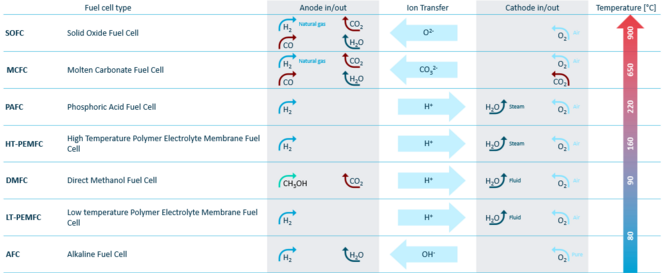
Fuel cells are categorized based on their choice of electrolyte, influencing their electro-chemical reactions, catalyst needs, operational temperature range, and fuel type. These distinctions determine the applications where each type of fuel cell excels. In general, six different types of fuel cells exist which are described below.
SOFCs are suitable for utility applications
Solid oxide fuel cells (SOFCs) use a hard, non-porous ceramic compound as the electrolyte. SOFCs typically achieve an efficiency of around 60%, which further increases to 85% if the waste heat is also utilized (co-generation). Because SOFCs are resistant to several orders of magnitude of sulphur and are not poisoned by carbon monoxide, natural gas, biogas and gases made from coal can be used as the fuel. SOFCs operate at very high temperatures—as high as 1,000°C eliminating the use of precious metals as catalysts. But high temperature operation also results in several disadvantages like slow startup, stringent durability requirements on materials and requirement of thermal shielding to retain heat and protect personnel. Due to such operating conditions, SOFCs are ideal for utility application but not for mobility application.
MCFCs do not require an external reformer
Molten carbonate fuel cells (MCFCs) are high-temperature fuel cells that use an electrolyte composed of a molten carbonate salt mixture suspended in a porous, chemically inert ceramic lithium aluminium oxide matrix. As they operate at high temperatures of 650°C, non-precious metals can be used as catalysts at the anode and cathode, reducing costs. Like SOFCs, MCFCs offer an efficiency of 65% which climbs to 85% if used in co-generation. An external reformer is not required to convert fuels like natural gas and biogas to hydrogen, as these fuels are converted into hydrogen within the fuel cell itself at high temperatures. The main disadvantage of MCFC is the accelerated component breakdown primarily due to the high temperature and corrosive electrolyte. MCFCs are typically used electrical utility, industrial or military applications.
PAFCs have relatively low efficiency of generating electricity
Phosphoric acid fuel cells (PAFCs) is considered the "first generation" of modern fuel cells. It is one of the most mature cell types and the first to be used commercially. PAFCs use liquid phosphoric acid as an electrolyte—the acid is contained in a Teflon-bonded silicon carbide matrix—and porous carbon electrodes containing a platinum catalyst. PAFCs are more than 85% efficient when used for the co-generation of electricity and heat but they are less efficient at generating electricity alone (37%–42%). PAFCs are also less powerful than other fuel cells, given the same weight and volume. As a result, these fuel cells are typically large and heavy. They require much higher loadings of expensive platinum catalyst than other types of fuel cells do, which makes them expensive. This type of fuel cell is typically used for stationary power generation, but some PAFCs have been used to power large vehicles such as city buses.
DMFC use methanol as the fuel to generate electricity
The majority of fuel cells are fueled by hydrogen, either directly supplied or produced within the system through the reforming of hydrogen-rich fuels like methanol, ethanol, and hydrocarbons. However, direct methanol fuel cells (DMFCs) operate specifically on pure methanol, typically mixed with water and delivered directly to the fuel cell's anode. DMFCs offer advantages in fuel storage compared to other fuel cell systems due to methanol's higher energy density relative to hydrogen, though it falls short of the energy density of gasoline or diesel. Methanol's liquid state also facilitates its transport and distribution within existing infrastructures, akin to gasoline. These features make DMFCs particularly suited for powering portable devices such as cell phones or laptops, representing a significant application area for this technology.
Low temperature operation of PEM fuel cells makes them suitable for transport application
Polymer electrolyte membrane (PEM) fuel cells, also known as proton exchange membrane fuel cells, exhibit notable advantages including high power density, compact size, and lightweight characteristics compared to alternative fuel cell technologies. Utilizing a solid polymer as the electrolyte and porous carbon electrodes embedded with a platinum or platinum alloy catalyst, PEM fuel cells rely on hydrogen, oxygen from the air, and water for their operation. Operating at relatively low temperatures, typically around 80°C, these cells offer quick start-up times and reduced component wear, enhancing their durability. However, the reliance on noble-metal catalysts, such as platinum, contributes to higher system costs and necessitates measures to counter carbon monoxide poisoning, particularly if the hydrogen source is derived from hydrocarbon fuels. Despite these challenges, PEM fuel cells find primary applications in transportation sectors, including cars, buses, and heavy-duty trucks, owing to their favorable characteristics and performance in vehicle settings.
AFC are similar PEM fuel cells, except that they use an alkaline membrane instead of an acid
Alkaline fuel cells (AFCs) utilize an electrolyte such as potassium hydroxide (KOH) solution and commonly function within a temperature range of approximately 60-250°C. AFCs represent one of the earliest iterations of fuel cell technology and were notably employed in manned space missions. These fuel cells have carved out specialized roles in scenarios where high-quality hydrogen is easily accessible, as observed in spacecraft and submarine environments.
Quellen:
US Departmet of Energy, Hydrogen and fuel cell technologies office: Types of fuel cells
Downloads
Hier informieren wir regelmäßig über alle wichtigen Entwicklungen im Bereich des Wasserstoffs, der Brennstoffzelle und des Elektrolyseurs.
Whitepaper: In-line Viscosity Measurement
Download a white paper on innovative solutions in the areas of real-time process monitoring and quality assurance
