
Fuel Cell Passenger Cars - Reliable or Futuristic Toy? A Comment
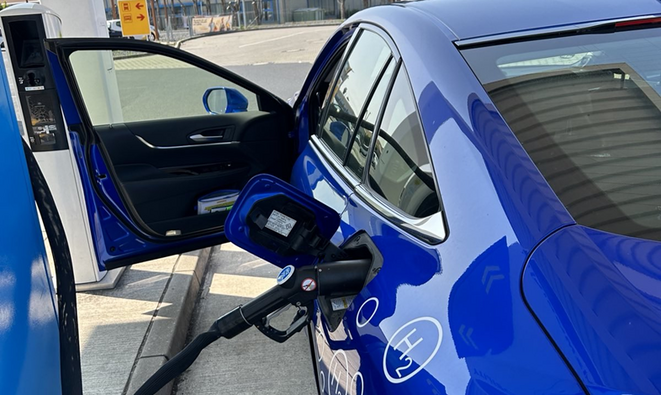
One possible solution for emission free mobility are fuel cell driven passenger cars, which brands like Toyota and Hyundai are offering with the promise of competitive range, dynamic driving behavior and short refueling times. The combination of silent, powerful and emission free mobility, as known from battery electric vehicles, is combined with the main uptakes of gasoline driven cars: Long range and short refueling. But can fuel cell vehicles keep these promises in today’s everyday use? An author of the Fuel Cell Compass tried with a Toyota Mirai for a week and reports his experience.
Fuel cell driven powertrains are similar to the ones of battery electric vehicles
Fuel cell powertrains are largely identical to those of battery electric vehicles, often using the same technology for power electronics, recuperative brakes, electric motors and energy management. The important difference is that instead of a large battery system, they store energy within a hydrogen tank and convert that hydrogen into electricity using a fuel cell. The hydrogen is stored under high pressures of up to 700 bars in order to increase the storable amount of energy, and the produced electricity is buffered with a very small battery.
Due to the similarity of the fuel cell vehicle drivetrain with the battery electric drivetrain, a comparable driving experience can be expected. The electric drivetrain silently converts the electric power to a very direct and linear acceleration behavior which is not interrupted by gear shifting or other engine related power output variations. The fuel cell operation is almost inaudible over standard driving sounds, such as wind and tire rolling noises, creating a silent and relaxed driving experience.
Ratio of fuel cell electric cars per refueling station is beneficial
Currently there are around 1,000 hydrogen refueling stations in operation worldwide, of which roughly 300 are based in Europe and ~ 100 of those are found in Germany. In contrast, there are around 14,000 gasoline refueling stations in operation in Germany today. Within a 50 km radius around the commuting start-point, there are four hydrogen refueling stations (HRS) in operation with a fifth one under construction, but only one of these can be reached on the commute with less than 15 minutes deviation as it is placed directly next to the motorway (5 min. deviation).
It is evident that the general infrastructure for fuel cell vehicles is still scarce and not comparable to conventional infrastructure, but with ~ 1800 fuel cell vehicles compared to ~ 49 million passenger cars listed in Germany in 2025 this vehicle class represents only a fraction of users. Therefore, the ratio of vehicles per station is comparably beneficial with ~ 18 vehicles per HRS compared to 3,500 vehicles per conventional refueling station.
Fuel is twice as expensive as for conventional vehicles
Over the one-week testing period with five workdays, a total distance of 650 km was driven, covering mainly highway commute combined with city-traffic. The average hydrogen consumption was 1.38 kg/100 km which adds up to ~ 9 kg of total hydrogen consumption. For an identical work week with a standard diesel-driven car, around 40 liters diesel are burned on average. These consumptions lead to weekly fuel costs of 144 € for hydrogen compared to ~ 65 € for diesel. In Germany emission free vehicles are excluded from vehicle taxes, but still the price difference is evident and significant.
While the hydrogen price in this case was around 16 € per kilogram, future hydrogen prices are expected to drop significantly with increasing production capacities and technology advancement. The international council on clean transportation estimates hydrogen costs for 2030 to reach 4-8 € per kilogram, cutting today’s prices at least in half. Together with increasing CO2-pricings for the upcoming years, hydrogen can be expected to surpass diesel economically, but the fact remains that today, commuting with a hydrogen powered vehicle remains twice as expensive as with conventional vehicles.
The experience from the practical test stresses the challenges
Driving to work silently and smoothly has its very own feeling, as battery electric vehicle drivers will acknowledge. The general driving experience can be described as relaxed, yet powerful and dynamic. The driving range of our four-year-old fuel cell vehicle with a full tank of 6 kg hydrogen amounts to around 400 km and poses serious competition for modern electric cars. Additionally, a full refueling is finished within 5 minutes and is completed as intuitively as diesel refueling while keeping the hands clean. In conclusion, the driving experience is as good as it is promised by fuel cell vehicle producers, in theory.
The practical test showed that the infrastructure still has a long way to go for fuel cell vehicles to pose a practical alternative for daily commuters. As the infrastructure is rather scarcely distributed, the full range of the vehicle can usually not be utilized, leading to refueling at 100 km remaining range. Since the refueling times are short and one of the four HRS is positioned directly at the highway with only five minutes of deviation, this would be fully acceptable for the environmental benefits and the enhanced driving experience. Yet, during our one week of testing this HRS has been offline due to technical reasons for around 3.5 out of 5 days, necessitating a refueling at one of the remaining three HRS with deviation times of 20, 30 and 35 minutes. As the next closest HRS, with a deviation time of 20 minutes, at the time of refueling was out of hydrogen at 700 bars (only 350 bars available leading to less than half the range), the third HRS had to be used for refueling, leading to a 30-minute deviation on a 50-minute commute (one way). For most commuters, this will not be acceptable for everyday use. While in this case a series of events combined to drastically increase the overall refueling efforts, the following two weeks all three of these HRS again experienced malfunctions and hydrogen shortages at least once per week. This experience showcases the need for technological advancements to elevate the user experience for hydrogen powered cars to a level of commodity that compares to conventional mobility.
As hydrogen vehicles and the corresponding infrastructure can be regarded as still premature compared to battery electric vehicles, large improvements might be expected over the next years, possibly making fuel cell vehicles a more favorable powertrain technology on the market. But today, these vehicles are rather fitted for real tech enthusiast that are ready to endure the evident setbacks of those who can afford a second or even third vehicle and aim for a smooth but powerful driving experience with a futuristic vehicle.
Sources
H2Stations, 2025: "Milestone reached: over 1,000 hydrogen refueling stations in operation worldwide in 2024"
Statista, 2025: "Anzahl der Tankstellen in Deutschland von 1950 bis 2024"
KBA, 2025: "Fahrzeugbestand am 1. Januar 2025"
ICCT, 2024: "The price of green hydrogen: How and why we estimate future production costs"
Downloads
Hier informieren wir regelmäßig über alle wichtigen Entwicklungen im Bereich des Wasserstoffs, der Brennstoffzelle und des Elektrolyseurs.
Whitepaper: In-line Viscosity Measurement
Download a white paper on innovative solutions in the areas of real-time process monitoring and quality assurance
