
"H2BUS Consortium Aims to Deploy 1000 Zero-Emission Fuel Cell Buses and Infrastructure Across Europe"
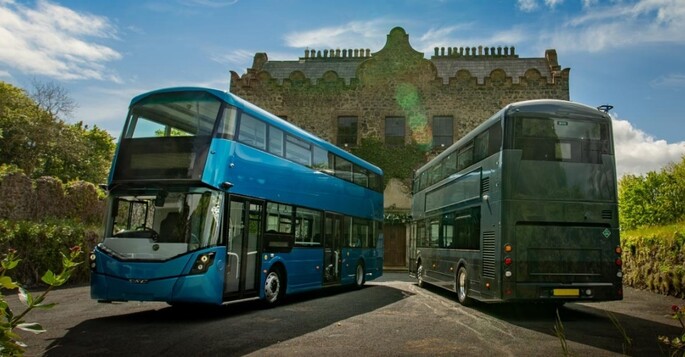
The H2BUS Consortium, established in 2019 and comprising Everfuel, Wrightbus, Ballard Power Systems, Hexagon Composites, Nel Hydrogen, and Ryse Hydrogen, aims to deploy 1,000 zero-emission fuel cell electric buses across Europe. To achieve this ambitious goal, the consortium plans not only to manufacture the buses but also to develop the necessary infrastructure in several European cities. This collaborative effort seeks to make the adoption of fuel cell technology for buses commercially competitive and environmentally sustainable.
Leading Experts in Fuel Cell Technology and Mobility Collaborate to Develop Hydrogen Fuel Cell Buses and Infrastructure
To be able to deploy 1,000 fuel cell electric buses across Europe, the involved companies are collaborating closely. The buses will be manufactured by Wrightbus, a Northern Ireland-based company that already offers a range of battery-powered and hydrogen-powered buses. For powering the buses, a fuel cell system from Ballard is used. The onboard hydrogen storage tanks will be supplied by Hexagon Composites.
The consortium's plan goes beyond just producing the buses; it also includes establishing the necessary infrastructure for hydrogen-powered buses. This will involve providing operators with a cost-effective and reliable supply of green hydrogen directly to their depots. Nel Hydrogen will supply the electrolysers and hydrogen stations, while Hexagon will deliver the hydrogen trailers essential for completing the hydrogen value chain. Everfuel and Ryse Hydrogen will be responsible for installing and managing the entire hydrogen infrastructure, ensuring the availability of hydrogen at bus depots. Ryse Hydrogen will oversee operations within the UK, while Everfuel will manage them across mainland Europe.
Developing a hydrogen bus for less than 375,000 €
The project aims to achieve a competitive overall operating cost. The price of a 12-meter single-decker bus is expected to be below €375,000. The basic model has a range of over 450 km, with an extended range option exceeding 675 km. Additionally, a 10.9-meter double-decker bus option will be available for less than €410,000, offering a standard range of over 310 km and an extended range of more than 420 km.
The hydrogen supply for the project is designed to achieve a completely emission-free well-to-wheel balance. "Well-to-wheel" refers to the total environmental impact and energy efficiency of hydrogen fuel from its initial production ("well") to its final use in the bus ("wheel"). This includes all stages, such as production, transportation, processing, and consumption.
To ensure emission-free operations, the hydrogen must be produced and transported without generating emissions. It will be produced from low-cost, renewable electricity at centralized hydrogen logistics centers and then transported to local bus depots using high-capacity hydrogen trailers. The consortium aims to achieve a hydrogen price of €5-7/kg.
The project scope also includes aspects such as vehicle service and staff training. Wrightbus is organizing the H2Bus maintenance to meet customer demands, offering a maintenance package at a rate of 0.30 € per kilometer. This program ensures that a comprehensive stock of spare parts, including standard and drivetrain components, is available and managed in each country.
Since the maintenance and handling of fuel cell and hydrogen systems differ significantly from conventional vehicles, specialized training for associated personnel is essential. Wrightbus and Ballard are collaborating on providing technical training on the bus and its components. These measures ensure a thorough understanding of the product and adherence to safety requirements.
First step: 600 busses across Europe
The first phase of the project focused on deploying a total of 600 fuel cell electric buses across Europe, with a target of rolling out 200 buses in each the UK, Latvia, and Denmark. This phase is being supported by €40 million in funding from the EU's Connecting Europe Facility program.
Following the initial rollout, additional countries, including Norway, Sweden, Germany, the Netherlands, and Belgium, are being considered for subsequent deployments.
Quellen:
Downloads
Hier informieren wir regelmäßig über alle wichtigen Entwicklungen im Bereich des Wasserstoffs, der Brennstoffzelle und des Elektrolyseurs.
Whitepaper: In-line Viscosity Measurement
Download a white paper on innovative solutions in the areas of real-time process monitoring and quality assurance
