
Hensel Recycling
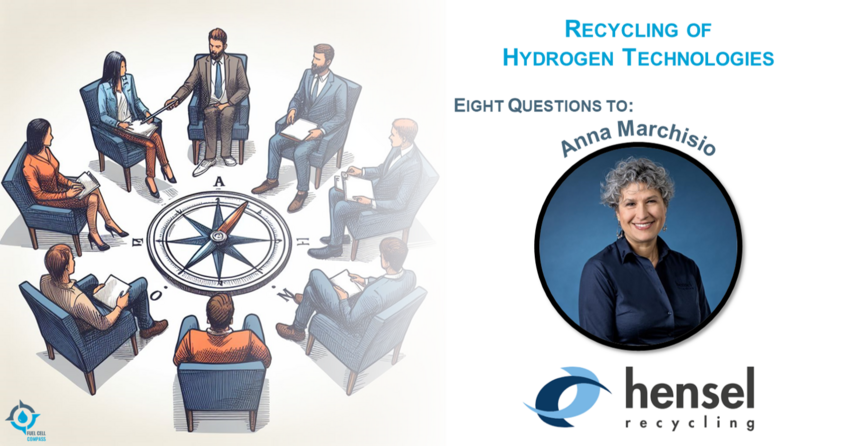
"We expect to see the first substantial EoL material streams in the next 10 to 15 years"
Hensel Recycling, a German company, is a global leader in precious metal recovery. The company specializes in recycling materials containing precious metals such as automotive and industrial catalysts, oxygen sensors, and electronic waste. Recently, it has expanded into hydrogen technology recycling, gaining valuable expertise through participation in research projects focused on recovering critical materials from PEM electrolysers and fuel cells.
Anna Marchisio, an expert in recycling critical raw materials, has been with Hensel Recycling for over 10 years. In this interview, she discusses the company’s approach to hydrogen technology recycling, its challenges, and future market potential.
Fuel Cell Compass: Hensel Recycling has primarily been involved in the recycling of other technologies. What motivated you to expand your portfolio to include the recycling of hydrogen technologies?
Marchisio: The search for new materials to recover has been a core element of our development since our founding in 1998. We were pioneers in the recycling of spent automotive catalysts, and over the years, we have added numerous other waste streams, including industrial, pharmaceutical, and biogas catalyst systems, heavy-duty catalysts, oxygen sensors, spark plugs, and most recently, e-waste. All these products contain critical raw materials essential to our society and the fight against climate change.
With the decline of internal combustion engines and the growth of the hydrogen economy, we considered it prudent to address the recovery of platinum group metals (PGMs) from PEM stacks and water electrolysers early on. Our goal was to become a forerunner in this promising niche market. Moreover, it makes little sense to develop sustainable technologies and use renewable energy sources if we do not also take responsibility for the waste streams they generate. This is a challenge we approach with great passion.
Fuel Cell Compass: What potential do you see for the recycling of hydrogen technologies? Are you focusing on specific technologies and components?
Marchisio: We believe that water electrolysers and stationary equipment represent the largest and most immediate candidates for critical raw material recovery. These systems are already in operation and have often been tested in research and development projects in recent years. However, the market is still immature, and end-of-life (EoL) flows are currently limited. In other regions, such as Southeast Asia, the situation is different, offering greater opportunities to address the recycling of mobile hydrogen technologies. At present, most of the materials we handle come from production waste, obsolete test and pilot equipment, or defective devices.
Fuel Cell Compass: In hydrogen technologies, there are two key points when defective parts arise: as production scrap and at the end of their lifecycle. Do you plan to handle both types of waste?
Marchisio: In fact, we are already dealing with both. This has provided us with an excellent opportunity to collaborate closely with manufacturers and industry stakeholders. Some players in the hydrogen industry are proactively anticipating the challenges of sustainably recovering their devices and have shown significant interest in environmentally friendly recycling techniques. This collaboration is mutually beneficial: we learn from each other and develop sustainable solutions together.
Fuel Cell Compass: How do you see the future of the market for recycling hydrogen technologies? Do you anticipate significant growth in this sector?
Marchisio: It is difficult to make reliable predictions, especially given the political uncertainties in many regions. However, many governments have made substantial investments in the hydrogen economy, and with so many ongoing projects, phasing out this technology is hardly an option. We expect to see the first substantial EoL material streams in the next 10 to 15 years. Until then, we continue to refine our processes, conduct tests, and build expertise.
Fuel Cell Compass: What challenges exist in recycling hydrogen technologies? Are there any technical, organizational, or regulatory uncertainties?
Marchisio: One of the biggest challenges we face is the lack of standardization. With numerous manufacturers and a wide variety of technical solutions, it is uncertain which designs will still be relevant in 10 to 15 years. Many of the devices we currently handle are test or pilot products, making the development of efficient disassembly and recycling processes challenging, especially for stacks and electrolysers.
From an organizational perspective, some manufacturers are considering take-back schemes for their products, while others do not see themselves as responsible for future waste streams. Questions regarding liability and warranties still need to be addressed. Policymakers have closely monitored the development and use of hydrogen technologies but have not yet focused on their EoL recycling. There is much work to be done in this area, and we are ready to contribute.
Fuel Cell Compass: Current research focuses on material advancements in fuel cells and electrolysers, such as PFAS-free membranes. How do such changes affect the recycling of hydrogen technologies?
Marchisio: Our cooperation with fuel cell, electrolyser, and ionomer manufacturers gives us valuable insight into the latest technological developments. Currently, burning large quantities of PFAS-containing membranes poses significant environmental and economic concerns. This is why we developed our Hy4cycle method, which is both environmentally friendly and cost-efficient, avoiding both burning and the use of acids. If future membranes are entirely PFAS-free, we would certainly welcome this evolution, as it would simplify the recycling process and improve economic feasibility.
Fuel Cell Compass: In the context of the circular economy, some experts suggest remanufacturing—replacing defective components rather than fully discarding systems. Could recycling companies play a role in this process?
Marchisio: This is a fascinating concept and should be further explored. Clearly, replacing and repairing individual components is more sustainable than dismantling an entire system. However, several aspects need careful evaluation, including the availability of appropriate testing equipment and the expertise required for such repairs. Intellectual property concerns also arise when manufacturers entrust third parties with verifying and repairing their products. While this idea presents great potential, implementing it successfully requires a culture of repair, shared responsibility, and new forms of collaboration.
Fuel Cell Compass: Are there any initiatives by hydrogen technology manufacturers to design products that facilitate recycling or remanufacturing at the end of their lifecycle?
Marchisio: As I mentioned earlier, we have the privilege of working closely with some manufacturers, and these discussions have been highly enriching. Some producers have shown strong interest in optimizing their devices for improved recyclability and have taken our recommendations into account. Conversations are ongoing to further enhance and simplify hydrogen technologies, benefiting all stakeholders involved.
Downloads
Hier informieren wir regelmäßig über alle wichtigen Entwicklungen im Bereich des Wasserstoffs, der Brennstoffzelle und des Elektrolyseurs.
Whitepaper: In-line Viscosity Measurement
Download a white paper on innovative solutions in the areas of real-time process monitoring and quality assurance
