
Hy-fcell 2024: Networking of the Component Manufacturing Branch
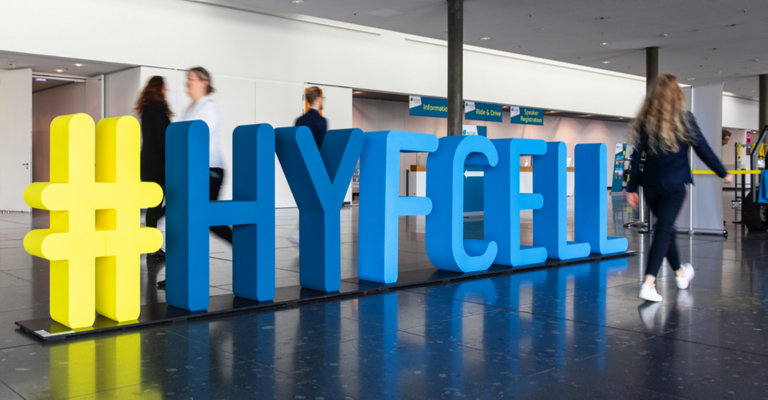
Production was the main topic at this year’s hy-fcell international exhibition and conference in Stuttgart, Germany from 8th to 9th October, where over 200 exhibitors showcased their innovative solutions with the majority of them being equipment manufacturers. The majority of the solutions were for the production of different fuel cell components, but the industry reaffirmed the need for industrialization and large scale manufacturing of electrolysers. Although one of the most important meeting point of the European hydrogen industry, the event was poorly attended over the span of two days, raising questions on the progress and confidence of the industry.
Poor attendance indicating a slow-down in the hydrogen industry?
“This year we see a very poor attendance in comparison to last year”, complained one of the booth owners. On one hand this could be due to the fact that there several exhibitions lined up one after another in October like the Hydrogen Technology Expo Europe in Hamburg and the Elektromobilproduktionstage (EPT) in Aachen, leading to different priorities.
On the other hand, a poor attendance might also indicate the declining confidence of the industry in fuel cell as a solution for decarbonization. While conversing with one of the equipment suppliers, Fuel Cell Compass was informed that the number of employees a company sends to an exhibition either as an exhibitor or as a visitor is an indicator of the relevance of the topic as well as a sign for the economical wellbeing of the company itself. On further discussion with other exhibitors, Fuel Cell Compass learned that equipment is available to ramp up the production, but the demand for fuel cells, electrolyzers its components and hence the production equipment is simply missing at the moment.
Lot of solutions seen for the manufacturing of bipolar plates
Several players showcased their solutions for the manufacturing of bipolar plates. Be it the forming step, coating step, joining step or leakage detection. Besides state of the art solutions, one of the manufacturer showcased his solution with wet coating of the target material on the bipolar plate followed by drying, eliminating the need for the energy intensive state of the art PVD coating step. Another manufacturer demonstrated clinching as an alternative technique of joining two bipolar half plates. Several manufacturers presented their solutions for the surface as well as weld quality inspection of bipolar plates. Overall, there were equipment suppliers, as well as "suppliers of suppliers", who were present on site.
Dedicated “University Area” for the first time
Leading Universities like RWTH Aachen University, BTU Cottbus, Technische Universität Wien, TU Delft and Westfälische Hochschule in collaboration with German Hydrogen Association (DWV) were offered the opportunity to showcase their exhibits relating to hydrogen and fuel cell technology. Overall there was good confluence of industry and academia showing their latest developments in the fuel cell and electrolyser technologies.
Downloads
Hier informieren wir regelmäßig über alle wichtigen Entwicklungen im Bereich des Wasserstoffs, der Brennstoffzelle und des Elektrolyseurs.
Whitepaper: In-line Viscosity Measurement
Download a white paper on innovative solutions in the areas of real-time process monitoring and quality assurance
