
Technological Process Deep Dive: Slurry Mixing for Fuel Cells and Electrolyzers
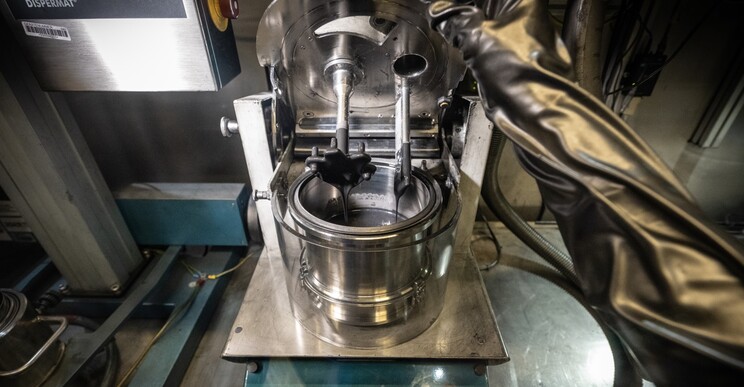
During the mixing process, relevant properties of the catalyst dispersion are set, such as viscosity. It is of utmost importance which process parameters are adjusted or which sequence is chosen for adding the individual components of the catalyst dispersion. Depending on the underlying technology, extensive process analysis and development are required to produce the catalyst dispersion reliably while avoiding costly waste. Therefore, this article discusses various methods used in the fuel cell and electrolyzer industry.
Shear Force and Ultrasonic Mixing as established methods
A shear force mixer consists of two main components: a stator and a rotor. The stator has fine openings through which the components of the catalyst dispersion are drawn into the center of the mixer by force applied by the rotor. Additionally, the high relative speed between rotor and stator breaks up agglomerates and finely distributes individual components among each other. During mixing, careful attention to temperature is required because added energy heats up the dispersion, potentially altering its chemical properties. The established use of shear force mixers and their relatively simple design are major advantages of this technology.
However, there are also disadvantages such as scaling issues or long process durations. Furthermore, material erosion of the tool can bring impurities to the dispersion.
Regarding ultrasonic technology, two different designs exist. In an ultrasonic bath, a container with the ink components is placed in a bath through which ultrasonic waves pass. In contrast, an ultrasonic horn generates waves directly through a rod immersed in the ink. The added ultrasonic waves create microscopic cavities in the liquid (cavitation). When these bubbles collapse, the resulting shear forces generate high pressure and temperature differences. This process, like that of a shear force mixer, breaks up agglomerates and disperses the particles within the dispersion. The strength of these forces can be regulated by adjusting the ultrasonic amplitude. A key advantage of this technology is its easy scalability and cleaning. However, the high energy consumption compared to a shear force mixer can be considered a disadvantage.
New technologies are emerging
With future production scaling, promising new technologies offer interesting benefits contributing cost reduction product quality improvement.
Extrusion Mixing
Instead of batch production (mixing per container), extrusion mixing is done continuously. This is achieved through a long tube with two parallel rotating screws that push the catalyst dispersion from one end to the other during mixing. The various phases, such as pre-mixing, kneading, fine dispersing, and degassing, are realized by adapting the screw shape at the relevant positions within the mixer. Additionally, there are various inlets and outlets to add substances or degas at later stages.
Extrusion mixing is easily scalable, ensures consistent product quality, and shortens process time. However, this comes with high maintenance costs. Additionally, the formulation should not be changed frequently in extrusion mixing, as this is very time-consuming and the cleaning time is significantly longer than with other solutions. Nonetheless, this technology presents an exciting option, especially for mass production.
Trajectory Mixing
In trajectory mixing, a mixing container is guided along a predetermined movement path. The movement path is created by two linear guides that, considering a phase offset, form a two-dimensional moving profile. Through this movement, the particles of the dispersion collide with each other as well as with the wall of the mixing chamber. These collisions lead to intensive mixing and comminution of the solids, ensuring that the particles are evenly distributed within the dispersion. By adjusting the movement path, the mixing process can be designed flexibly.
The main advantages of trajectory mixing are shorter mixing and cleaning times while maintaining consistent quality. However, the process still needs to be evaluated for fuel cell and electrolyzer technology but shows great potential for mass production based on experiences in battery production.
The mixing process is crucial - and still offers potential
In summary, it can be concluded that the mixing process plays a key role in fuel cell and electrolyzer production and has a significant impact on subsequent cell performance. Established technologies, such as shear force or ultrasonic devices, already exist for laboratory and lab-scale production. However, alternative technologies are being investigated and evaluated with an eye toward scaling up production. Examples include extrusion or trajectory mixing, which are exciting approaches being discussed in the industry.
Source
Heiner Heimes, Mario Kehrer, Sebastian Hagedorn, Julius Hausmann, Gerd Krieger, Jana Müller: Produktion von Brennstoffzellenkomponenten (October 2022)
Achim Kampker, Heiner Heimes, Sarah Wennemar, Gerrit Bockey, Peter Stellbrink, Bernhard Hunkelmann: Whitepaper Trajectory Mixing (April 2023)
Fa Bühler: Mixing Technologies for Lithium-Ion Battery Slurry and Fuel Cell
Downloads
Hier informieren wir regelmäßig über alle wichtigen Entwicklungen im Bereich des Wasserstoffs, der Brennstoffzelle und des Elektrolyseurs.
Whitepaper: In-line Viscosity Measurement
Download a white paper on innovative solutions in the areas of real-time process monitoring and quality assurance
